
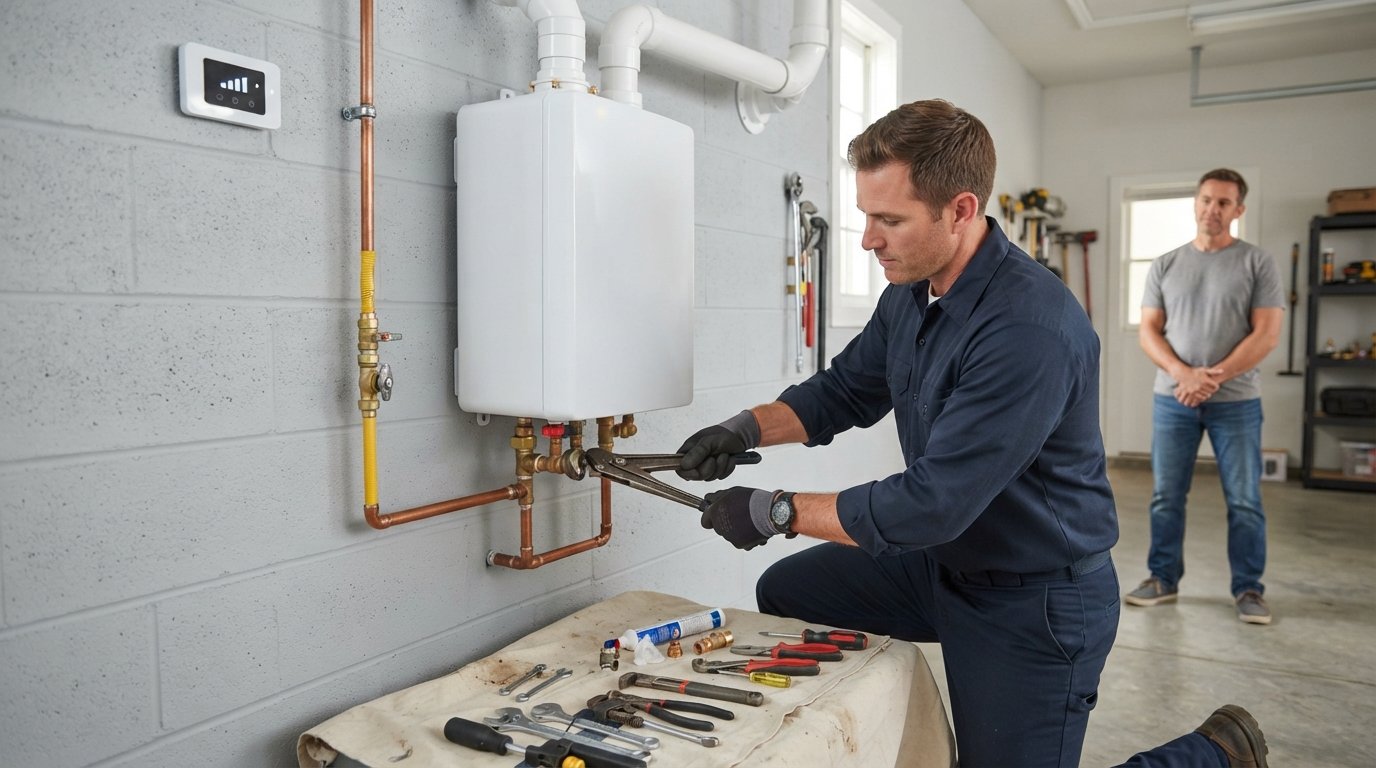
Tankless Water Heater Installation: Pros, Cons, Costs
Tankless water heater installation pros cons and costs explained, from endless hot water to retrofit expenses. Call 8334393727 for local quotes.
By Danica Leslie
Learn more about Water Heater Installation or Replacement for guides, costs, and what to expect.
Compare Water Heater Installation or Replacement Pros Near You

Enter your ZIP code to compare top-rated local professionals and request free quotes.
Upgrading to a tankless water heater is one of the most appealing home improvements for homeowners who are tired of running out of hot water during a shower or paying to keep a 50-gallon tank warm all day. The promise of endless hot water, lower utility bills, and a space-saving design is genuinely attractive. But the decision is rarely as simple as swapping one box for another. Tankless water heater installation pros cons and costs vary widely depending on your home's existing plumbing, gas or electrical capacity, and local building codes. Before you commit, it pays to understand exactly what you are buying, what the installation really involves, and where the hidden expenses tend to appear.
This guide breaks down the real-world advantages and drawbacks of tankless systems, explains how installation pricing works in 2026, and gives you a practical framework for deciding whether a tankless upgrade makes sense for your household. If you would rather compare numbers from local pros before you decide, you can request free quotes from vetted contractors through our referral network and see how pricing looks in your area.
How Tankless Water Heaters Actually Work
A tankless water heater, also called an on-demand water heater, heats water only when you turn on a hot tap or start an appliance that needs hot water. Cold water flows through a heat exchanger, where either a gas burner or electric heating elements raise the temperature to your set point. Because there is no storage tank, the unit does not sit around keeping dozens of gallons hot 24 hours a day. That is the core reason tankless systems can cut standby heat loss, which is the energy a traditional tank wastes just keeping water warm between uses.
The trade-off is that a tankless unit must be sized to handle the peak simultaneous demand of your home. A single shower might need 2 to 3 gallons per minute of hot water, but a shower plus a dishwasher plus a washing machine can push demand past 6 or 8 gallons per minute. Gas tankless units typically deliver higher flow rates than electric models, which matters in larger households. If the unit cannot keep up, you get temperature fluctuations, not a total loss of hot water, but enough to notice.
Installation is where the real story lives. A tankless unit is not a direct one-for-one replacement for a tank. It often requires a larger gas line, upgraded venting, a new electrical circuit, or a water softener in hard-water regions. Those requirements are the main reason installation costs vary so dramatically from home to home.
The Pros of Tankless Water Heater Installation
The benefits of tankless systems are real, but they are conditional. They show up most clearly in homes with moderate hot water demand, available gas infrastructure, and owners who plan to stay in the house long enough to recoup the higher upfront cost. Here are the advantages homeowners ask about most.
- Endless hot water: As long as the unit is sized correctly, you can run back-to-back showers without waiting for a tank to recover.
- Lower standby energy losses: Because there is no stored hot water, you avoid the constant cycling that tank heaters use to maintain temperature.
- Space savings: Wall-mounted units free up several square feet of floor space, which is a real benefit in garages, closets, and small utility rooms.
- Longer service life: Tankless units often last around 20 years with proper maintenance, compared with roughly 10 to 12 years for a standard tank.
- Better for some remodels: If you are finishing a basement or converting a garage, a tankless unit can be tucked into a wall cavity instead of eating up a corner of the new living space.
Those advantages are why tankless systems have become a common upgrade in remodeling projects. In our homeowner-focused guide on tankless water heater pros and cons, we walk through how to match unit size to household demand so you do not pay for capacity you will never use, or worse, buy a unit that cannot keep up.
It is also worth noting that the energy savings are usually modest, not dramatic. A tankless unit might cut water heating energy use by 20 to 30 percent in a typical home, but that is a fraction of your total utility bill. The bigger financial case often comes from longevity and space, not from month-to-month savings alone.
The Cons and Practical Drawbacks
The drawbacks of tankless systems are mostly about installation complexity and upfront cost, not performance. Homeowners who expect a simple swap are often surprised by what the job actually requires. The most common pain points include the following.
- Higher purchase and installation cost: The unit itself costs more, and the labor to install it is often significantly higher than a tank replacement.
- Retrofit requirements: Many homes need a larger gas line, new venting, an upgraded electrical panel, or a dedicated circuit.
- Hard water sensitivity: Mineral buildup can shorten the life of the heat exchanger, so a water softener or regular descaling is often necessary.
- Flow rate limits: Running too many fixtures at once can cause temperature swings, especially with electric units.
- Maintenance needs: Annual descaling and occasional part replacement are part of ownership, not optional extras.
The retrofit issue is the one that catches most people off guard. A standard tank water heater often vents through a metal flue that goes straight up through the roof. A high-efficiency tankless unit usually needs a different venting setup, sometimes PVC pipe routed through a side wall. If your home does not have a convenient path for that vent, the installer may need to cut into walls or run a longer vent, which adds cost and time.
Gas line capacity is another common obstacle. Many homes have a half-inch gas line feeding the water heater, but a tankless unit may need a three-quarter-inch line to supply enough BTU input. Running a new gas line from the meter is skilled work and requires permits in most jurisdictions. Electric tankless units avoid the gas line problem but often require a 200-amp service and multiple dedicated circuits, which can mean a panel upgrade.
What Tankless Water Heater Installation Costs in 2026
Cost is the single biggest factor in the tankless decision, and it is also the most variable. National averages for a full installation, including the unit and labor, generally fall between $2,000 and $5,500, with many homeowners landing around $3,000 to $4,000. High-end condensing gas units with complex venting runs can exceed $6,000. Simple electric replacements in a home with adequate wiring can sometimes come in under $2,000.
The spread is wide because the unit is only part of the bill. Here is how the major cost components typically break down.
- Unit cost: $800 to $2,500 depending on fuel type, capacity, and efficiency rating.
- Labor: $500 to $2,000 for a straightforward install, more if the job requires extensive plumbing or electrical work.
- Gas line or electrical upgrades: $300 to $1,500, sometimes higher if a panel upgrade is needed.
- Venting modifications: $200 to $800 depending on the route and materials.
- Permits and inspections: $100 to $500, varying by city and county.
- Water softener or descaling setup: $500 to $2,500 if hard water is an issue.
Comparing that to a tank replacement, which usually runs $800 to $1,800 installed, makes the upfront gap obvious. The payback period for tankless is often 8 to 15 years when you factor in energy savings and longer service life, which means it rarely makes sense if you plan to sell in the next few years. For homeowners staying long term, the math can work, especially if the installation is simple and the home already has the right infrastructure.
Local conditions matter a lot. In areas with hard water, add descaling equipment to the budget. In older homes with undersized gas lines, add a plumbing upgrade. In cold climates, add considerations for freeze protection and condensate management. A reputable contractor will walk through your specific setup before quoting, which is why getting multiple estimates is so important.
How to Decide If Tankless Is Right for Your Home
The decision comes down to three practical questions: how much hot water you actually use, what your existing infrastructure can support, and how long you plan to stay in the home. If you have a large family that runs multiple showers at once, a gas tankless unit with a high flow rate can be a genuine upgrade. If you live alone, take short showers, and have an older home with limited gas capacity, a high-efficiency tank may be the smarter financial choice.
It also helps to think about the project holistically. If you are already remodeling a bathroom or finishing a basement, the marginal cost of running a new gas line or vent during that work is often lower than doing it as a standalone job later. Bundling the water heater upgrade with other work can reduce labor costs and disruption.
Before you sign anything, take these steps:
- Get at least three written estimates that itemize the unit, labor, permits, and any required upgrades.
- Ask the contractor to confirm the unit is sized for your peak demand, not just your square footage.
- Verify licensing, insurance, and local permit history before work begins.
- Confirm who handles warranty service and how long the heat exchanger is covered.
Homes.Contractors does not perform installations or guarantee contractor work, so independent verification is always your responsibility. What the platform does offer is a faster way to gather comparable quotes from pre-vetted local pros, which makes it easier to spot an outlier bid and to understand what a fair price looks like in your market.
Finally, consider maintenance from day one. A tankless unit that is never descaled will not last 20 years. Budget for annual service, or learn to flush the unit yourself if you are comfortable with basic plumbing tasks. That single habit protects the investment more than any other factor.
Bottom Line on Tankless Water Heater Installation
Tankless water heaters are a solid upgrade for the right household, but they are not a universal win. The pros, endless hot water, lower standby losses, space savings, and longer life, are real. The cons, higher upfront cost, retrofit complexity, and ongoing maintenance, are equally real. The deciding factor is usually your home's existing infrastructure and how long you plan to stay. Run the numbers with local quotes, confirm the unit is sized correctly, and treat the installation as a system upgrade rather than a simple appliance swap. Do that, and you will know within a few estimates whether tankless is the right call for your home.