
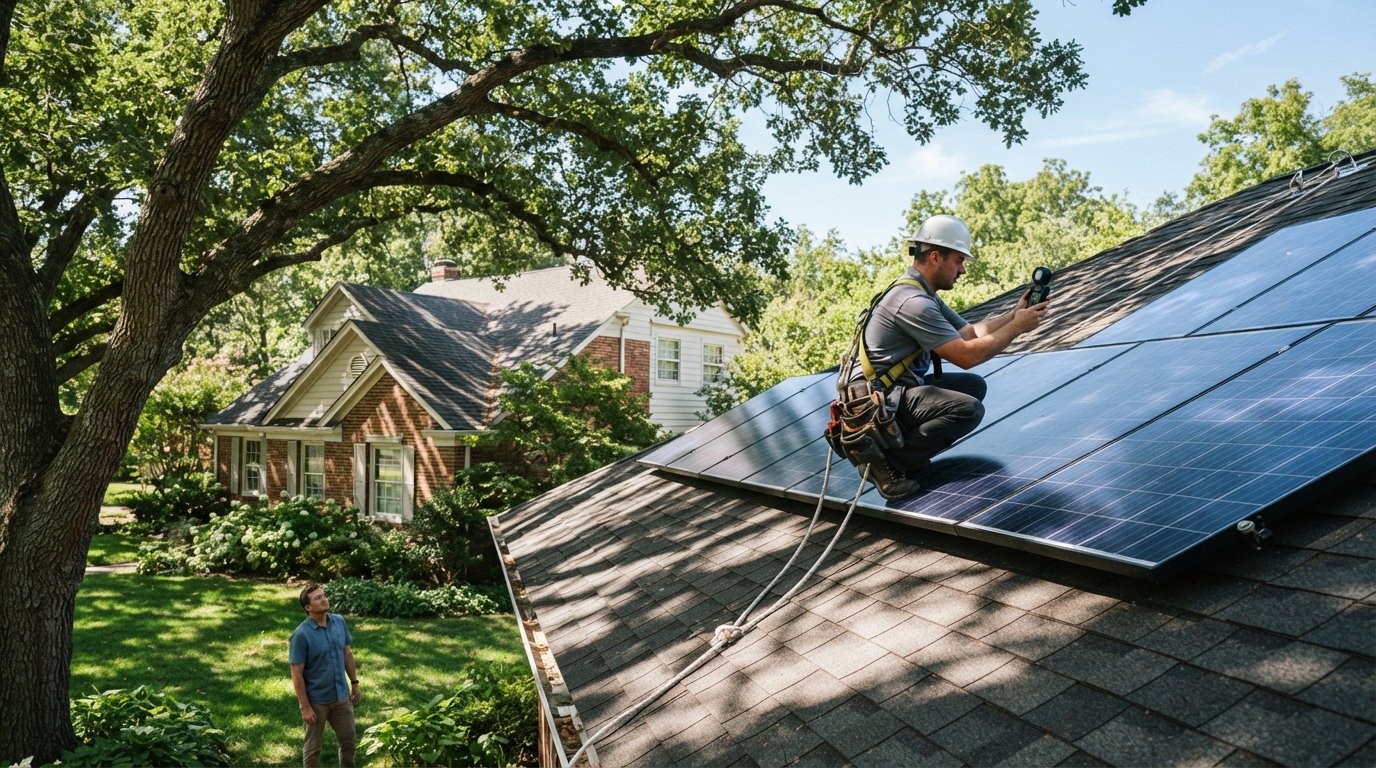
Solar Cost for a Shaded Roof: Real Numbers and Options
Solar on a shaded roof can still save money with the right approach. Call (833)-439-3727 to compare local installer quotes and options.

By Maya Griffin
Learn more about Solar Panel Installation and Repair for guides, costs, and what to expect.
Compare Solar Panel Installation and Repair Pros Near You

Enter your ZIP code to compare top-rated local professionals and request free quotes.
A shaded roof does not automatically disqualify your home from solar savings, but it does change the math. Many homeowners assume that a few trees or a north-facing slope means solar is off the table, yet the reality is more nuanced. The cost of solar for a house with a shaded roof can range from a few thousand dollars for a small ground-mounted system to nearly nothing upfront for a community solar subscription, depending on how you approach the problem. Understanding why shade matters, how installers measure it, and what alternatives exist will help you make a confident decision without wasting money on a system that underperforms.
Why Shade Matters More Than You Think
Solar panels generate electricity in proportion to the amount of sunlight they receive. Even a small shadow, such as the shadow of a chimney or a single tree branch, can disproportionately reduce output because of how panels are wired. In a traditional string inverter system, panels are connected in series, so the weakest panel drags down the performance of the entire string. A shadow covering just 10 percent of one panel can cut the output of that string by 50 percent or more. This is why shade assessment is the first step in any solar evaluation.
Modern equipment can mitigate some of this loss. Microinverters and DC optimizers allow each panel to operate independently, so shading on one panel does not affect the others. However, these devices add cost, typically 10 to 20 percent more than a standard string inverter system. Even with this technology, heavy shade during peak sun hours will still reduce production and extend your payback period. The key is to quantify the loss before you commit. A professional shade report will model the sun's path across the year and estimate production losses from each obstruction, giving you a realistic picture of what your roof can actually produce.
How Installers Measure Shade and Model Production Losses
Solar installers use a combination of satellite imagery, on-site measurements, and software modeling to assess shade. They typically create a shade report using tools like Solmetric SunEye or Aurora Solar, which simulate the sun's movement and calculate the solar access percentage for each roof plane. This report will show you how many hours of direct sunlight your roof receives on an average day and how much production you can expect to lose compared to an unshaded roof in the same area.
The modeling accounts for seasonal variations, tree growth, and even the angle of the sun in winter versus summer. A reputable installer will share this report with you and explain the assumptions behind it. Beware of any installer who promises a specific production number without showing you a shade analysis. If your roof has significant shading, the report may recommend microinverters or a ground-mounted system instead. Use this information to compare quotes and understand why one installer might propose a smaller system than another.
Roof Condition and Orientation Checks Before You Commit
Before you even think about panel placement, your roof must be structurally sound and have at least 10 to 15 years of remaining life. Solar panels can last 25 to 30 years, so installing them on a roof that needs replacement in five years is a costly mistake. If your roof is older or shows signs of wear, you should plan to replace it before or during the solar installation. This adds to the overall cost but avoids the expense of removing and reinstalling panels later.
Orientation also matters. In the United States, south-facing roofs are ideal, but east- and west-facing roofs can still produce respectable output, especially with modern panels. North-facing roofs are generally poor candidates for solar unless you have a steep tilt or significant shading on other sides. A qualified installer will evaluate your roof's pitch, azimuth, and available space to determine the best layout. If your roof is shaded or unsuitable, they may suggest ground-mounted panels or a community solar program instead.
Ground-Mount, Community Solar, and Battery-Only Options
If your roof is heavily shaded, you have several alternatives that can still deliver financial benefits. The best choice depends on your property, budget, and goals. Here are the main options to consider:
- Ground-mounted solar: Panels are installed on a frame in your yard, where you can often avoid shade and optimize tilt and orientation. Ground mounts typically cost 10 to 20 percent more than roof mounts due to additional racking, trenching, and permitting, but they can be the only way to access solar production on a shaded lot.
- Community solar: You subscribe to a share of a larger solar farm and receive credits on your electricity bill. This requires no installation and no upfront cost, and it is ideal for renters or homeowners with unsuitable roofs. Savings are usually modest (5 to 15 percent off your electric bill) but predictable.
- Battery-only with time-of-use rates: If your utility has high time-of-use rates, you can charge a battery from the grid during off-peak hours and use it during peak hours. This is not solar, but it can reduce your electric bill without any panels. It makes sense if you have reliability concerns or want backup power.
- Solar plus battery with a small ground mount: A hybrid approach can maximize savings if you have limited sunny space. A small ground-mounted array paired with a battery can cover part of your usage and provide backup during outages.
Each option has different cost structures and payback periods. Ground-mounted systems qualify for the federal solar tax credit (30 percent through 2032), while community solar subscriptions do not. Battery-only systems also qualify for the tax credit if paired with solar, but standalone batteries do not. You will need to run the numbers for your specific situation to see which makes the most sense.
Realistic Payback Timelines with Reduced Production
Shade reduces production, which extends the payback period. A typical unshaded residential solar system in the U.S. costs between $15,000 and $25,000 before incentives and has a payback period of 7 to 12 years, depending on electricity rates and local incentives. With moderate shade (20 to 30 percent production loss), that payback can stretch to 10 to 15 years. With heavy shade (50 percent or more), solar may never pay back on a roof mount, which is why ground mounts or community solar become more attractive.
To estimate your payback, you need three numbers: the net cost of the system after the federal tax credit and any local rebates, the estimated annual production in kilowatt-hours, and your current electricity rate. Divide the net cost by the annual savings (production multiplied by rate) to get a simple payback in years. For example, a $20,000 system with a 30 percent tax credit costs $14,000 net. If it produces 7,000 kWh per year and your rate is $0.15 per kWh, annual savings are $1,050, and payback is about 13.3 years. If shade cuts production to 5,000 kWh, savings drop to $750 and payback extends to 18.7 years. These numbers illustrate why an accurate shade report is critical.
Questions to Ask Solar Installers About Shade Reporting
When you request quotes from solar installers, ask specific questions to ensure they are accounting for shade properly. A trustworthy installer will welcome these questions and provide clear answers. Here are the key points to cover:
- Can you provide a shade report? Ask for a report that shows solar access percentages for each roof plane and the estimated production loss due to shading. If they cannot provide one, consider another installer.
- What equipment do you recommend for shaded roofs? Microinverters or DC optimizers can mitigate shade losses. Ask why they recommend a particular option and how it affects the overall cost and production estimate.
- How do you model tree growth and seasonal shade? Trees grow, and shade patterns change. A good installer will account for future growth and show you how the system will perform in December versus June.
- What is the expected payback period with the shade losses included? Compare this to your own calculations and ask for the assumptions behind their numbers.
- Do you offer ground mounts or community solar if the roof is unsuitable? If your roof is heavily shaded, a full-service installer may still be able to help with a ground mount. If not, they should refer you to a community solar provider.
Getting multiple quotes is essential, and you can use a platform like Homes.Contractors to request free quotes from pre-vetted local solar installers. They can help you compare proposals and understand the fine print, especially when shade is a factor.
Cost Ranges for Shaded Roof Scenarios
To give you a ballpark, here is how solar costs break down for different shaded roof situations. These are national averages and will vary by location, system size, and equipment choice.
- Light shade (10 to 20 percent loss): A standard 6 kW roof-mounted system with microinverters costs $16,000 to $22,000 before the 30 percent tax credit, or $11,200 to $15,400 net. Payback is typically 8 to 12 years.
- Moderate shade (20 to 40 percent loss): You may need a larger system to compensate, or you might opt for a ground mount. Costs range from $18,000 to $28,000 before incentives, with payback of 10 to 15 years.
- Heavy shade (over 40 percent loss): Roof-mounted solar is usually not cost-effective. A small ground mount (3 to 4 kW) costs $12,000 to $18,000 before incentives, or you might choose community solar with no upfront cost.
These numbers are for illustration only. Your actual costs will depend on your roof's complexity, local labor rates, permitting fees, and available incentives. Always get at least three quotes and review the shade reports carefully.
Maximizing Savings Despite Shade
If you decide to proceed with solar on a shaded roof, there are ways to improve the economics. First, choose high-efficiency panels and microinverters to squeeze the most out of limited sunlight. Second, consider trimming or removing trees that cause the most shade, but check local regulations and consider the cooling benefits of shade before you cut. Third, size the system appropriately: overbuilding to compensate for shade can waste money if the added panels are also shaded. Fourth, take advantage of all available incentives, including the federal tax credit, state rebates, and utility programs. Finally, consider pairing solar with a battery to store excess production and use it during peak rates, which can improve payback even with lower overall production.
If you also need a backup power source, you might explore a whole-house generator as a complement to solar. In our guide on whole house generator installation cost and sizing, we explain how to evaluate that option. For many homeowners with shaded roofs, a generator plus community solar can be a practical combination.
Finally, do not overlook the value of professional guidance. A solar installer who specializes in shaded roofs can help you navigate the trade-offs and avoid common pitfalls. Use a directory like PlanRemodel to find qualified contractors in your area and read reviews from other homeowners. With the right information and a careful approach, you can still achieve meaningful energy savings even if your roof is not ideal for solar.