
Whole House Generator Installation Cost and Sizing Guide
Get a clear picture of whole house generator installation cost and sizing. Call (833)-439-3727 for expert guidance and avoid costly mistakes.

By Aaron Turner
Learn more about Generator Installation for guides, costs, and what to expect.
Compare Generator Installation Pros Near You

Enter your ZIP code to compare top-rated local professionals and request free quotes.
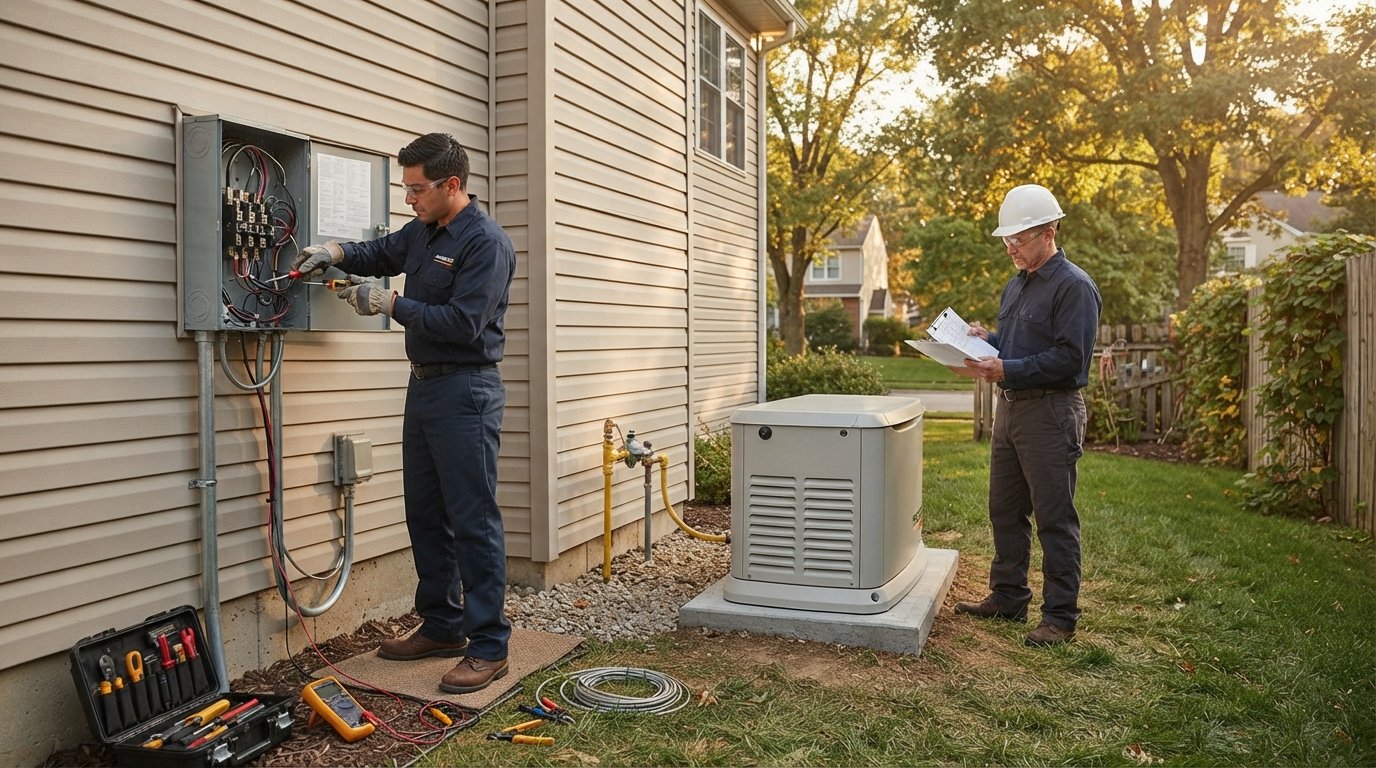
When the power goes out, a whole house generator can keep your lights on, your food cold, and your family comfortable. But before you buy, you need to understand two critical factors: how much a whole house generator installation costs and how to size the unit correctly for your home. Get either wrong, and you could waste thousands of dollars or end up with a system that cannot handle your electrical load. This guide breaks down the real numbers, the sizing math, and the installation steps so you can plan with confidence.
Understanding Whole House Generator Costs
The total cost of a whole house generator installation typically ranges from $10,000 to $25,000 or more, depending on the generator size, fuel type, and installation complexity. For a mid-range 20 kW natural gas unit, homeowners often pay between $12,000 and $18,000 installed. Larger 30 kW systems for big homes with electric heat or multiple AC units can exceed $25,000. These figures include the generator itself, the automatic transfer switch, permits, and professional installation by a licensed electrician.
It is important to distinguish between the equipment cost and the installation cost. The generator unit alone might cost $4,000 to $10,000, while the transfer switch adds $800 to $2,000. Installation labor, electrical wiring, gas line work, and concrete pad can add another $5,000 to $12,000. In regions with strict permitting or older homes needing panel upgrades, expect the higher end of that range. For a deeper look at how smart home upgrades interact with generator planning, see our guide on smart home installation costs and planning.
Ongoing costs also matter. Annual maintenance runs $150 to $300, and you should budget for fuel costs during extended outages. Propane generators consume 2 to 4 gallons per hour under load, which can add up quickly. Natural gas is often cheaper per BTU but requires a dedicated gas line with sufficient pressure. We will explore fuel tradeoffs later, but first, let us tackle sizing.
How to Size a Whole House Generator
Sizing a generator is not about matching your home square footage; it is about calculating your electrical load. You need to decide whether you want to power the entire house or just essential circuits. A whole house generator must handle your home's peak demand, which occurs when multiple large appliances start at once. Starting watts (surge) can be two to three times higher than running watts for motors in air conditioners, furnaces, and refrigerators.
To size accurately, list all the appliances and systems you want to run during an outage. Then note their running watts and starting watts. For a true whole house setup, you need to account for central AC, electric range, water heater, well pump, and all lighting and outlets. A qualified electrician will perform a load calculation using the National Electrical Code (NEC) guidelines. As a rough estimate, a 2,000 square foot home with natural gas heat and a central AC typically needs a 14 to 20 kW generator. Homes with electric heat or multiple AC compressors may need 22 to 30 kW.
If you choose a managed whole house approach, the generator can shed non-essential loads automatically, allowing a smaller unit to power the entire house sequentially. This is often more cost-effective than buying a larger generator. For example, a 20 kW managed system can run the AC, then the oven, then the water heater in sequence, never all at once. Essential circuit sizing is another option: you power only critical items like the furnace, refrigerator, well pump, and a few lights. That might require only a 7 to 10 kW generator, significantly reducing cost.
Essential Circuits vs. Whole House Sizing
Choosing between essential circuit backup and whole house backup is a budget and lifestyle decision. Essential circuit backup costs less upfront and uses less fuel, but you may need to manually manage which devices are plugged in. Whole house backup offers seamless comfort but requires a larger generator, a bigger transfer switch, and more fuel storage. Many homeowners compromise with a managed whole house system that covers everything but limits simultaneous high-draw appliances.
Fuel Types and Storage Tradeoffs
Whole house generators run on natural gas, propane, or diesel. Natural gas is convenient because it is piped directly to your home, so you never run out of fuel. However, you need a gas line with adequate pressure and volume; sometimes the utility must upgrade the meter. Propane requires an on-site tank, typically 250 to 500 gallons for extended outages. Propane is more expensive per gallon than natural gas but works in rural areas without gas service. Diesel is efficient but requires more maintenance and fuel polishing to prevent degradation.
Fuel storage is a major cost factor. A 500-gallon propane tank costs $1,000 to $2,500 installed, and you must keep it filled. During a long outage, a 20 kW generator might burn 2 to 3 gallons per hour, so a 500-gallon tank lasts about a week if you conserve. Natural gas has no storage cost but may be unavailable during widespread disasters if the utility loses pressure. Many experts recommend a dual-fuel setup or a propane tank with a natural gas conversion kit for flexibility.
Maintenance also varies by fuel. Propane and natural gas generators require regular oil changes and spark plug replacement. Diesel systems need fuel filters and water separators. Always follow the manufacturer's maintenance schedule to keep your warranty valid. Annual service contracts cost $200 to $400 and include a load test, oil change, and inspection.
Permits, Electrical Panel Work, and Transfer Switch Basics
Installing a whole house generator requires permits from your local building department. The process typically involves an electrical permit and a mechanical or gas permit. Fees range from $100 to $500, but the real cost is compliance: your installation must meet NEC and local codes. A licensed electrician will handle the permit application and schedule inspections. Do not skip this step; unpermitted work can void your insurance and create liability issues.
The automatic transfer switch (ATS) is the heart of the system. It disconnects your home from the utility grid and connects it to the generator when power fails. The ATS must be rated for your generator's output and your home's service panel. For whole house backup, a service-rated ATS is installed between the meter and the main panel. For essential circuit backup, a smaller ATS can be installed next to the main panel to feed a subpanel. Transfer switches cost $800 to $2,000, and installation labor adds $500 to $1,500.
Electrical panel work is often necessary. Older homes may have a 100-amp panel that cannot handle the additional load of a generator. Upgrading to a 200-amp panel costs $1,500 to $3,000. You may also need to free up breaker spaces or replace outdated wiring. A qualified electrician will assess your panel during the site survey and include any upgrades in the quote.
Installation Cost Breakdown and Ongoing Maintenance
To help you budget, here is a typical cost breakdown for a 20 kW natural gas whole house generator installation:
- Generator unit: $5,000 to $8,000
- Automatic transfer switch: $800 to $1,500
- Concrete pad and mounting: $200 to $500
- Electrical wiring and conduit: $1,000 to $2,500
- Gas line installation or upgrade: $500 to $2,000
- Permits and inspections: $200 to $500
- Labor: $2,000 to $4,000
Total installed cost: $9,700 to $19,000. For larger systems or complex installations, expect the higher end. Ongoing maintenance includes annual service ($150 to $300), fuel costs, and occasional battery replacement for the ATS (every 3 to 5 years, $100 to $200). Over a 15-year lifespan, maintenance can add $3,000 to $5,000, so factor that into your budget.
Finding a licensed electrician and a reputable generator dealer is crucial. Look for dealers certified by the manufacturer (Generac, Kohler, Briggs & Stratton) and electricians with experience in standby systems. Ask for references and verify insurance. You can also use a directory like PlanRemodel to find pre-vetted contractors in your area. Always get at least three quotes and compare the scope of work, not just the price.
Finding Licensed Electricians and Generator Dealers
Start by checking your state's licensing board to confirm an electrician's license is active and in good standing. Ask whether they carry general liability insurance and workers' compensation. For generator dealers, look for factory-authorized service providers who can handle warranty claims. A good dealer will perform a site survey, calculate your load, and explain the differences between air-cooled and liquid-cooled generators. Air-cooled units are cheaper and adequate for most homes up to 22 kW; liquid-cooled units last longer and are quieter for larger homes.
Get written estimates that detail the generator model, transfer switch type, fuel source, permitting responsibilities, and warranty terms. Be wary of quotes that seem too low; they may exclude permits, gas line work, or panel upgrades. A professional installer will also discuss placement: the generator must be at least 5 feet from windows, doors, and property lines in many jurisdictions, and it needs proper clearance for exhaust and airflow. Noise levels matter too; air-cooled units produce 60 to 70 decibels at 23 feet, while liquid-cooled units are quieter.
Finally, plan for the future. If you are considering solar or battery backup, a generator can be integrated with a smart home energy management system. But that requires careful planning during installation. For most homeowners, a whole house generator is a reliable, long-term investment in comfort and safety. By understanding sizing and costs, you can avoid surprises and choose a system that fits your budget and needs.