
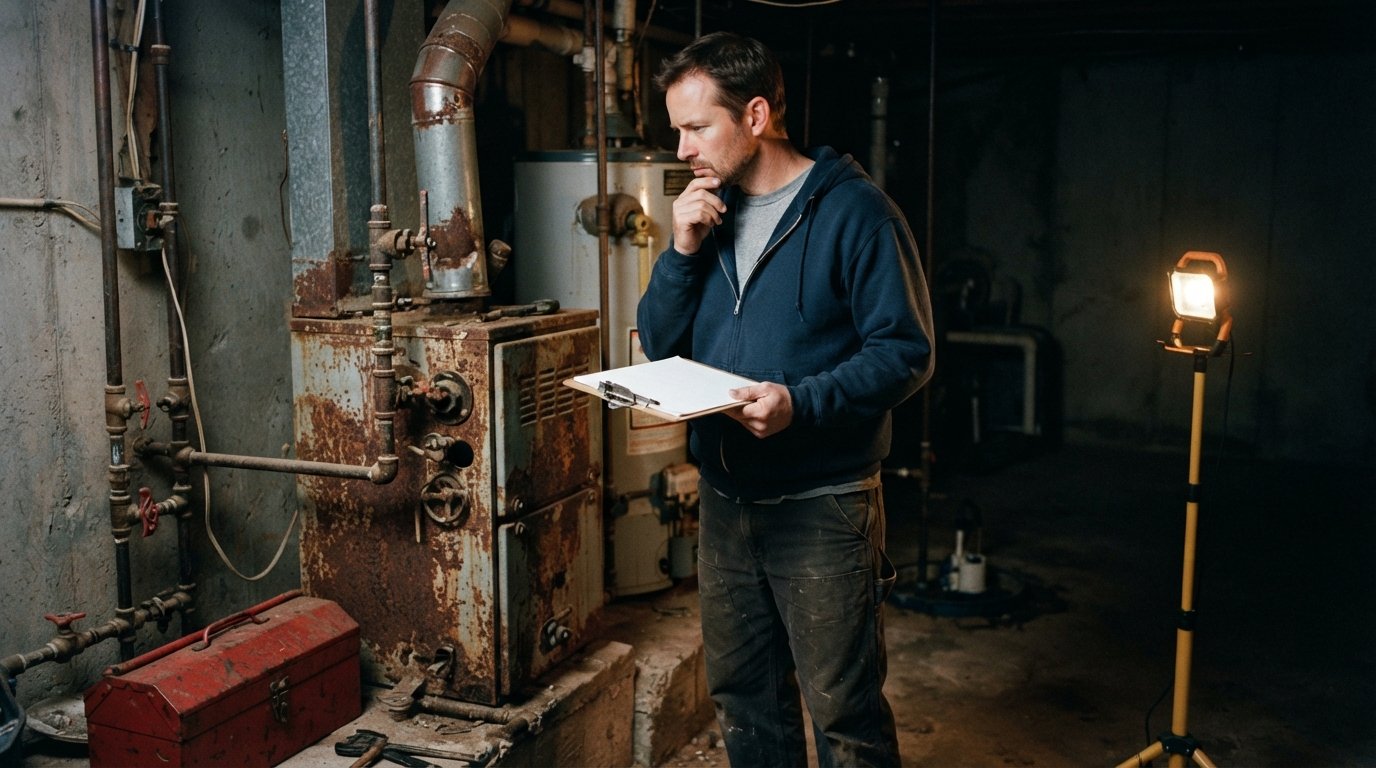
Repair Versus Replace Guide for Major Home Systems
Use this repair versus replace guide for major home systems to decide with confidence. Call (833)-439-3727 for vetted contractor quotes.

By Leo Dawson
Learn more about General Contracting for guides, costs, and what to expect.
Compare General Contracting Pros Near You

Enter your ZIP code to compare top-rated local professionals and request free quotes.
Your furnace dies in January, your roof is leaking after a storm, and your water heater is making a sound like gravel in a blender. Each crisis forces the same uncomfortable question: do you patch what you have or start over? The answer is rarely obvious, and contractors have a financial incentive to lean one way or the other. This repair versus replace guide for major home systems gives you a clear framework so you can make the call with confidence, protect your budget, and avoid throwing money at equipment that is already living on borrowed time.
The 50% Rule and Age-Based Decision Criteria
The most widely used rule of thumb in the trades is simple: if a repair costs more than half the price of a new system, replacement deserves serious consideration. The logic is that once you cross that threshold, you are paying for a short-term fix on equipment that will likely need another expensive repair soon. That said, the 50% rule is a starting point, not a verdict. A $600 repair on a $1,200 water heater sounds like a coin flip until you learn the unit is only four years old and still under warranty for parts, in which case repair wins easily. The rule works best when combined with the age of the equipment and its expected service life.
Age matters because every major system has a typical lifespan. HVAC equipment generally lasts 12 to 18 years, water heaters run 8 to 12 years for tank models and up to 20 for tankless, and asphalt shingle roofs last 20 to 25 years. If your system is past 75% of its expected life and needs a repair costing more than a third of replacement, replacement is usually the smarter financial play. If it is young and the repair is minor, fix it and keep the warranty intact. The table below summarizes how the two criteria interact.
- Young system, cheap repair: Repair. The equipment has years left, and replacement would waste that value.
- Young system, expensive repair: Get a second opinion. A repair over 50% of replacement cost on a young unit often signals a defect, so check the warranty first.
- Old system, cheap repair: Repair, but start budgeting for replacement within one to three years.
- Old system, expensive repair: Replace. You are otherwise paying premium prices for depreciated equipment.
One more factor deserves a place in the decision: efficiency. An old system that guzzles energy can cost you more in monthly bills than a new unit would cost in finance charges. If your equipment is more than 15 years old and you plan to stay in the home for several years, replacement often pays for itself through lower utility bills even when the repair math looks close.
Applying Repair-Versus-Replace Logic to HVAC, Water Heaters, and Roofs
Each major system has its own failure patterns, and understanding them helps you interpret a contractor's recommendation. HVAC systems are the most common source of this dilemma because they contain multiple expensive components. A failed compressor on a 15-year-old air conditioner is almost always a replacement trigger, since the compressor alone can cost 40% to 60% of a new system and the rest of the equipment is near the end of its life. A failed capacitor or blower motor on a 7-year-old furnace, by contrast, is a straightforward repair. Refrigerant leaks are trickier: a small leak that can be sealed may justify repair, but repeated leaks in older equipment usually point toward replacement.
Water heaters follow a similar logic with a few unique warning signs. A leaking tank is an automatic replacement, because tank leaks cannot be repaired reliably and the unit is at risk of flooding your home. A failed heating element or thermostat on a tank that is otherwise sound is a cheap fix. Sediment buildup that causes rumbling and reduced hot water capacity is a judgment call: flushing may help temporarily, but if the tank is past eight years old, replacement is usually the better investment. Tankless units have longer lifespans and more repairable components, so they often justify repair well into their second decade.
Roofs present the highest-stakes version of the decision because failure can cause interior damage far beyond the roof itself. A single missing shingle or a small flashing leak is a repair. Widespread granule loss, curling shingles, and multiple leaks across different areas point to replacement. The age of the roof is the strongest signal: a 20-year-old asphalt roof with storm damage is rarely worth patching, while a 10-year-old roof with one damaged section can be repaired and blended with the existing shingles. For a deeper look at how this logic applies to paved surfaces, the principles in this asphalt driveway repair versus replacement decision guide translate well to roofs and other exterior systems.
When Repair Costs Exceed Half the Replacement Cost
Crossing the 50% threshold is a signal to slow down and ask harder questions, not a command to replace. The first question is whether the repair buys you meaningful time. A $900 repair on a $1,500 water heater buys a few years at most, while the same $900 repair on a $6,000 HVAC system buys years on a unit with a much longer remaining life. The second question is whether the repair is a one-time event or the latest in a pattern. One repair in five years is normal maintenance. Three repairs in 18 months means the system is telling you something, and the cumulative cost of those repairs is the number that matters, not the price of any single visit.
You should also consider what the repair does not fix. Replacing a failed part on an aging system leaves the other aging parts in place, so you may be back on the phone in six months. Contractors sometimes call this the repair spiral: each fix is affordable on its own, but the total exceeds replacement within a year or two. Ask your contractor directly whether the repair addresses the underlying cause or just the symptom, and whether other components are showing wear. A good technician will tell you honestly when a repair is throwing good money after bad.
Finally, factor in the disruption cost. Replacing a system involves permits, scheduling, and a day or two without heat or hot water. Repairing avoids most of that, which has real value during extreme weather. But if you are facing a major repair in the middle of summer with a 15-year-old air conditioner, the comfort argument often favors replacement because the new unit will not fail again next month.
Energy Efficiency Gains from Replacing Old Equipment
Efficiency is the hidden variable in the repair-versus-replace equation. A furnace installed in 2005 might run at 80% efficiency, while a modern unit can reach 96% or higher. A water heater from the same era may waste 30% more energy than a current model. Those percentage points translate directly into monthly bills, and over a decade the savings can offset a meaningful share of the replacement cost. If your system is old and inefficient, the repair-versus-replace decision is really a question about total cost of ownership, not just the sticker price of the repair.
Rebates and tax incentives can tip the scale further. Federal and utility programs often offer credits for high-efficiency HVAC systems, heat pump water heaters, and energy-efficient roofing materials. These incentives effectively reduce the replacement cost, which changes the 50% calculation in favor of replacement. Before you authorize a major repair, ask your contractor whether any incentives apply to a new installation, and check whether your utility offers free energy audits that quantify the savings. The audit report gives you a documented number to compare against the repair quote.
Efficiency gains also matter for resale. Buyers inspect major systems, and a recently replaced roof or HVAC unit is a selling point that supports your asking price. An aging system with a recent repair record raises questions and can become a negotiation liability. If you plan to sell within a few years, replacement often pays back twice: once through lower bills while you own the home, and again through a smoother sale.
How to Get Professional Assessments and Second Opinions
You should never make a major repair-or-replace decision on a single contractor's word. The person diagnosing your system has a financial interest in the outcome, and even honest technicians see the situation through the lens of the work they perform. A second opinion is not an insult to the first contractor; it is standard practice for any purchase of this size. When you request assessments, ask each contractor to put the recommendation in writing with the repair cost, the replacement cost, the expected remaining life of the equipment, and the efficiency comparison. That written record makes it much easier to compare recommendations side by side.
Getting multiple quotes is the most reliable way to pressure-test a recommendation. The platform behind this guide connects homeowners with pre-vetted local contractors and lets you request several free quotes for the same project, so you can see whether the first diagnosis holds up. You can review service directories for vetted contractors in your area and compare their assessments before committing. When the quotes disagree, ask each contractor to explain the reasoning behind their recommendation, and pay attention to whether they address the age and efficiency factors discussed above.
Professional assessments should include a few specific elements. For HVAC, ask for a load calculation and a combustion safety test, not just a visual inspection. For water heaters, ask about the anode rod condition and whether the tank interior shows corrosion. For roofs, ask for photos of the damaged areas and an assessment of the remaining life of the shingles. A contractor who cannot or will not provide this level of detail is not giving you enough information to make a sound decision. You should also verify licenses and insurance independently, since no referral platform can guarantee the quality of work performed.
Timing matters too. If your system fails during a heat wave or cold snap, you may face pressure to decide immediately. In that situation, authorize the repair that restores function, then take your time on the replacement decision. Emergency repairs are not the moment for a rushed capital purchase. Once the immediate crisis passes, gather your second opinions and run the numbers calmly.
Building a Decision Framework You Can Reuse
The best way to handle this decision is to prepare before the emergency arrives. Keep a simple record of the age, model number, and service history for each major system in your home. When a repair quote arrives, you can immediately calculate the repair-to-replacement ratio and check the equipment's age against its expected lifespan. Homeowners who maintain this record consistently make faster, calmer decisions and avoid the premium prices that come with emergency replacements.
As a practical framework, run through these questions in order: How old is the system relative to its expected life? What is the repair cost as a percentage of replacement? Is this the first repair or part of a pattern? How much efficiency would a new system gain? Are incentives available? What do multiple contractors recommend in writing? If the answers point in different directions, weight age and repair frequency most heavily, because those are the strongest predictors of future cost. A young system with a cheap repair is an easy fix; an old system with a major repair is an easy replace; everything in between deserves a second opinion.
Finally, remember that the goal is not to avoid spending money but to spend it where it returns the most value. A well-timed replacement protects your home, lowers your bills, and adds to its resale appeal. A well-judged repair preserves the value of equipment that still has years of service left. With a clear framework, written assessments from multiple contractors, and a little patience, you can make the call that fits your home and your budget.
Learn more about General Contracting for guides, costs, and what to expect.
Compare General Contracting Pros Near You
Enter your ZIP code to compare top-rated local professionals and request free quotes.