
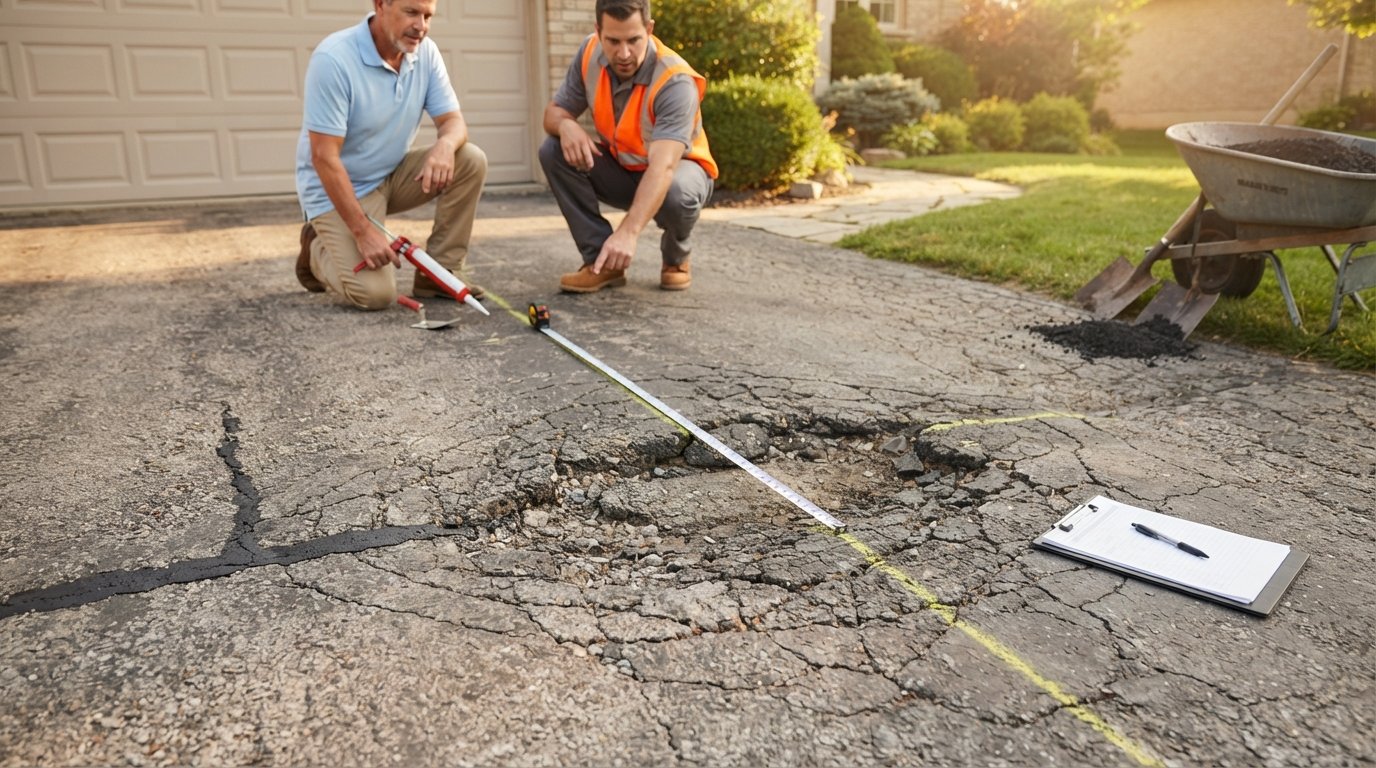
Asphalt Driveway Repair Versus Replacement Decision Guide
Use this asphalt driveway repair versus replacement decision guide to avoid paying twice. Call 8334393727 for trusted local contractor quotes.

By Alice Miller
Learn more about Asphalt Repair and Maintenance for guides, costs, and what to expect.
Compare Asphalt Repair and Maintenance Pros Near You

Enter your ZIP code to compare top-rated local professionals and request free quotes.
A cracked, crumbling asphalt driveway does more than ruin your home's curb appeal. It can become a safety hazard, a drainage problem, and a costly headache if you choose the wrong fix. The real question is not whether you can patch it, but whether patching it now will cost you more later. This asphalt driveway repair versus replacement decision guide walks you through the exact factors contractors use to make that call, so you can budget with confidence and avoid paying twice for the same stretch of pavement.
Why the Repair or Replace Decision Matters More Than You Think
Asphalt is not a permanent surface. It is a flexible pavement that expands and contracts with temperature swings, and it depends on a stable base beneath it to stay flat and intact. When that base stays dry and well drained, a properly installed asphalt driveway can last 15 to 20 years. When water gets underneath, the surface damage you see is usually a symptom of a deeper structural problem.
That distinction drives everything. A surface crack caused by sun exposure and minor aging is a maintenance issue. A web of cracks spreading from a sunken area is often a base failure, and no amount of sealant will fix it. If you repair the symptom and ignore the cause, the damage returns within a season or two, and you have spent money that could have gone toward a permanent solution.
Homeowners also tend to underestimate how much timing matters. A driveway that fails early in its life usually points to installation problems, poor drainage, or heavy vehicle loads. A driveway that fails after 15 good years is simply at the end of its service life. Same cracks, very different recommendations.
The Core Factors That Decide Repair Versus Replacement
Contractors evaluate several conditions before recommending a path. None of them alone is decisive, but together they form a clear picture. The most important is the condition of the subbase, the compacted gravel and soil layer under the asphalt. If the subbase has shifted, softened, or settled, the surface will keep failing no matter how many patches you apply.
Age is the second major factor. Most asphalt driveways reach the end of their useful life between 15 and 20 years, assuming regular maintenance. If yours is in that range and showing widespread deterioration, replacement is usually the more economical long term choice. If it is under 10 years old and the damage is localized, repair is often the smarter move.
Drainage is the third factor, and it is the one homeowners overlook most often. Water is asphalt's worst enemy. If your driveway slopes toward the house, has no positive drainage away from the surface, or sits in a low spot that holds water, repairs will keep failing until the drainage is corrected. Sometimes the fix is a simple regrade. Sometimes it requires reworking the entire subbase.
Finally, consider how you use the driveway. A standard passenger vehicle puts far less stress on asphalt than a heavy truck, RV, or trailer. If your driveway regularly carries heavy loads, the pavement needs a thicker, better compacted base, and repairs to a standard depth will not hold up.
Repair Options and When They Actually Work
Repair is not one single technique. It covers a range of treatments, from cheap cosmetic fixes to structural repairs that extend a driveway's life by years. The key is matching the method to the problem.
Here are the most common repair methods and the situations where each one makes sense:
- Crack filling: Best for isolated cracks under half an inch wide with no surrounding settlement. Inexpensive, fast, and effective as preventive maintenance.
- Patching: Suitable for potholes and small broken areas where the base underneath is still solid. A good patch can last several years if water is kept out.
- Sealcoating: A protective layer that slows oxidation and water intrusion. It is maintenance, not a structural fix, and it will not hide or correct an unstable base.
- Mill and overlay: Grinding off the top layer and paving a new one. Works when the base is sound but the surface is worn, cracked, or raveling.
- Full-depth patching: Removing the asphalt and damaged base in a specific area, rebuilding the base, and repaving that section. Used for isolated structural failures.
Each of these has a realistic lifespan. Crack filling might buy you two to three years. A quality patch can hold for five or more if drainage is corrected. A mill and overlay can add 8 to 12 years when the base is stable. The moment the base is compromised across a large area, these repairs become temporary bandages, and the money is better spent on replacement.
Signs Your Driveway Is Beyond Repair
Some damage patterns point clearly to replacement. Learning to recognize them saves you from sinking money into a surface that cannot be saved.
Watch for alligator cracking, the web-like pattern of interconnected cracks that resembles reptile scales. This almost always signals a failing subbase, and it spreads. Watch for depressions and sinkholes where the pavement has settled into voids below. Watch for crumbling edges that no longer hold their shape, and for large areas where the asphalt has become brittle and raveled.
Another strong indicator is widespread patching. If your driveway already looks like a patchwork quilt from previous repairs, adding more patches rarely improves appearance or performance. At that point, the surface has lost its structural integrity, and the next round of repairs will not be the last.
Puddling is the final warning sign. If water stands on the driveway for hours after rain, the surface is no longer draining correctly. That standing water seeps into cracks, freezes in winter, and accelerates every other problem on this list.
Cost Comparison: What You Will Actually Pay
Cost is where the repair versus replacement decision gets practical. Repair is almost always cheaper upfront. Replacement is often cheaper over a 10 to 15 year window because it resets the clock instead of delaying the inevitable.
As a general range, small crack filling and patching cost a few hundred dollars. Sealcoating typically runs several hundred dollars for an average driveway and needs to be redone every two to three years. A mill and overlay costs significantly more but can extend the life of a sound driveway by a decade. Full replacement costs the most upfront, but it comes with a fresh 15 to 20 year lifespan when installed correctly.
The trap is repeated repair. If you spend money on patches three times over five years, you may have spent close to half the cost of replacement without solving the underlying problem. Run the numbers over a decade, not over a single season, and the right choice usually becomes obvious.
Before you commit to either path, get written estimates from multiple local paving contractors. A reputable platform like PlanRemodel connects homeowners with pre-vetted contractors and lets you compare quotes side by side, which is the fastest way to see whether local pros agree on repair or replacement.
How to Evaluate Contractor Recommendations
Not every contractor has your long term interest in mind. Some push replacement because it is a bigger job. Others push repair because it is quick and easy to sell. Your job is to ask questions that separate honest assessments from sales pitches.
Start by asking what is happening beneath the surface. A good contractor will inspect the base, check drainage, and explain why the damage occurred. If the answer is only about the top layer, be cautious. Ask how long the proposed repair is expected to last, and get that estimate in writing. Ask whether the underlying cause, whether drainage, base failure, or heavy loads, will be addressed.
You should also verify credentials independently. Confirm licensing where required, ask for proof of insurance, and check references from similar jobs. For a deeper walkthrough of the evaluation process, see this guide on asphalt driveway repair or replace, which covers the same decision from a homeowner's perspective.
Get at least three estimates and compare scope, not just price. One bid may include base repair and drainage work while another only resurfaces the top. Those are not the same job, and the cheaper bid is often cheaper for a reason.
A Simple Decision Framework You Can Use
If you want a fast way to organize your thinking, work through these steps in order:
- Inspect the base. If the subbase is failing across a large area, lean toward replacement.
- Check the age. Under 10 years with localized damage favors repair. Over 15 years with widespread damage favors replacement.
- Evaluate drainage. If water is not moving away from the surface, correct that first or the repair will fail.
- Count the patches. A driveway already covered in patches rarely benefits from another one.
- Run the 10 year math. Compare the total cost of repeated repairs against a single replacement.
This framework will not give you a perfect answer every time, but it will keep you from making an emotional decision based on appearance alone. Most driveways fall clearly into one category once you work through these five questions honestly.
Preventing the Next Decision From Being Expensive
Whichever path you choose, maintenance determines how long it lasts. A new or repaired driveway should be sealcoated after the asphalt cures, typically six months to a year after installation. Keep cracks filled as they appear, keep edges supported, and keep water moving away from the surface.
Avoid parking heavy vehicles on the same spot repeatedly, and do not let oil or chemical spills sit on the surface. These small habits add years to the life of any driveway and delay the next repair versus replacement decision as long as possible.
When the time comes, approach it like any other home improvement project: gather multiple quotes, verify the contractor, and choose based on scope and value rather than the lowest number. Do that, and you will get a driveway that looks right, drains right, and holds up for the long haul.