
How to Budget for a Whole House Rewire in an Older Home
Budget a whole house rewire in an older home without surprise bills. Call (833)-439-3727 for vetted electricians and a clear phased plan.

By Maya Griffin
Learn more about Wiring Installation for guides, costs, and what to expect.
Compare Wiring Installation Pros Near You

Enter your ZIP code to compare top-rated local professionals and request free quotes.
If you own an older home, you have probably heard the phrase "you need a full rewire" from an electrician, a home inspector, or a nervous neighbor. The number attached to that phrase can feel staggering, often landing between $10,000 and $30,000 or more depending on the size and age of your house. But a whole house rewire is not a single lump sum you must produce overnight. It is a scope of work that can be broken down, phased, and budgeted with the same discipline you would apply to a kitchen remodel or a roof replacement. The key is understanding what drives the cost, what can wait, and how to plan for the surprises that older wiring almost always hides inside the walls.
This guide walks you through the real numbers, the warning signs that force the project, and the step-by-step process of building a realistic rewire budget. You will learn how to separate safety-critical work from cosmetic upgrades, how permits and inspections fit into the timeline, and how to vet an electrician so the bid you accept is the price you actually pay. Along the way, you will see how to compare multiple quotes and avoid the trap of choosing the cheapest bid for a job that literally powers your home.
Why a Whole House Rewire Costs More Than You Expect
A rewire is not just a box of wire and a few outlets. In an older home, the electrical system is often woven into the structure in ways that require opening walls, fishing cable through finished spaces, and upgrading the service panel to handle modern loads. The labor alone can account for 50 to 70 percent of the total cost because electricians must work around plaster, lath, insulation, and sometimes asbestos or lead paint. If your home was built before 1950, the chances are high that you have knob-and-tube wiring, which insurance companies increasingly refuse to cover. If it was built between 1965 and 1973, you may have aluminum branch wiring, a known fire hazard that requires special connectors or full replacement.
Beyond the wiring itself, a full rewire usually triggers a panel upgrade. Modern homes need 200-amp service to handle central air, electric ranges, heat pumps, and EV chargers. An older 60-amp or 100-amp panel will not pass inspection for a modern load calculation, so the budget must include a new panel, new breakers, and often a new meter base and grounding system. In many jurisdictions, the utility company must also disconnect and reconnect power, which adds coordination costs and a day or two without electricity. When you add patching and painting after the electrician leaves, the true all-in cost of a rewire can climb 20 to 30 percent above the electrical bid alone.
Geography matters too. In dense urban markets like Miami or Houston, labor rates and permit fees run higher than in rural Ohio. A 1,500-square-foot home in a high-cost metro might see bids from $18,000 to $28,000, while a similar home in a lower-cost region could land between $9,000 and $15,000. The lesson is not to anchor on a national average but to collect local bids and compare scope line by line.
Warning Signs That Force the Budget Conversation
Not every old home needs an immediate full rewire. Sometimes a partial upgrade and targeted repairs can buy you five to ten years. But certain red flags should move the project from "someday" to "this year" because they represent active fire or shock hazards. The most common triggers include knob-and-tube wiring, aluminum branch circuits, two-prong ungrounded outlets, and breakers that trip repeatedly under normal loads. Flickering lights, warm or discolored outlet covers, and a burning smell near the panel are emergency signals that warrant an immediate electrician visit.
Insurance companies are another forcing function. Many carriers now ask for a four-point inspection on homes older than 25 or 30 years, and they will refuse to write or renew a policy if knob-and-tube or aluminum wiring is present. If you are buying an older home, your lender may require the seller to remediate before closing. Even if you are not selling, a rewire can lower your premiums and remove a barrier to future refinancing.
Here are the key warning signs to document before you call for bids:
- Knob-and-tube wiring visible in the attic, basement, or behind switch plates
- Aluminum branch wiring on 15- or 20-amp circuits (often found in homes built 1965 to 1973)
- Two-prong outlets with no ground, especially in kitchens, bathrooms, and bedrooms
- Breakers that trip when you run a microwave and a toaster at the same time
- A fuse box instead of a circuit breaker panel, or a panel with no open slots
- Buzzing, warm, or discolored outlets and switches
Once you have documented the issues, you can ask electricians to bid on a scope that addresses the hazards first. That leads directly to the phased approach that makes a rewire budget manageable.
What a Full Rewire Actually Involves
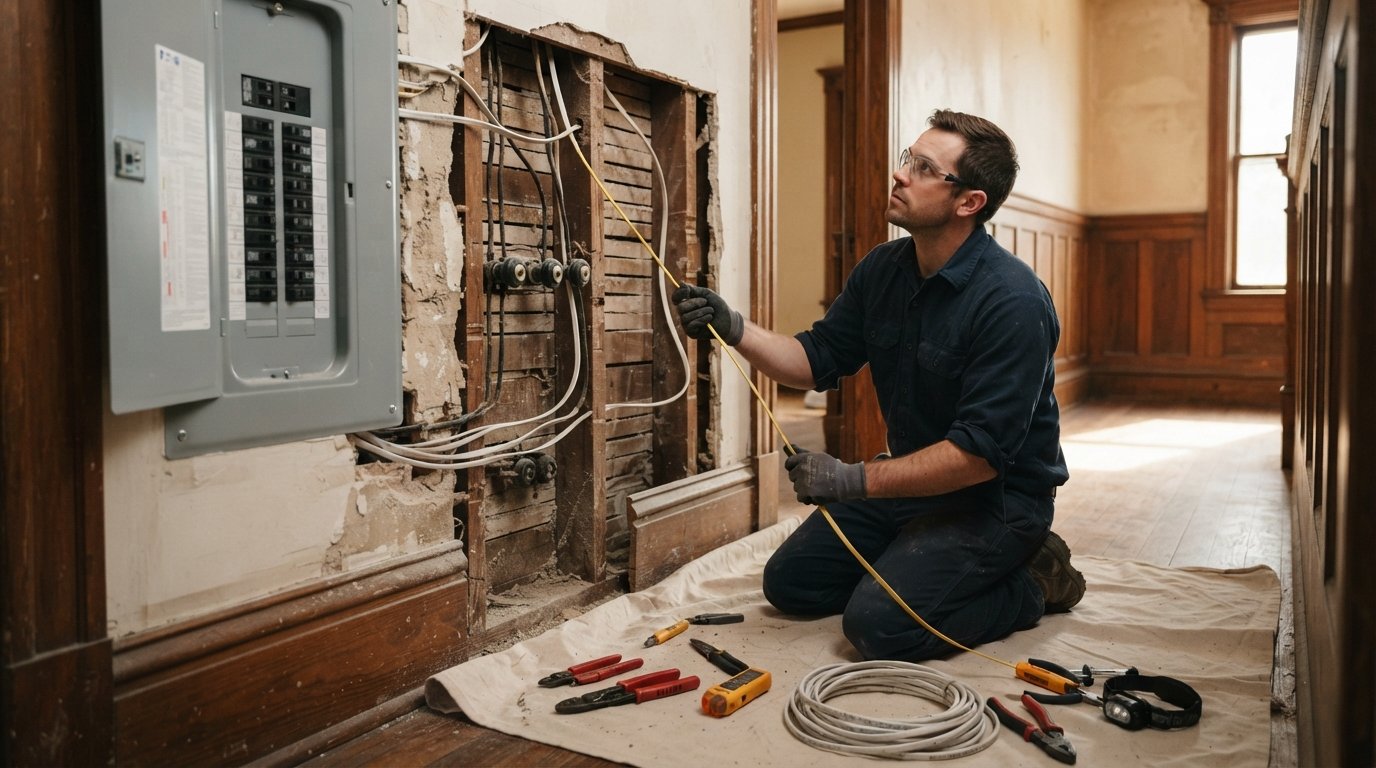
A whole house rewire is a sequence of connected tasks, and each one has a cost you can estimate. The electrician will first map the existing circuits and identify what can be reused. In most older homes, very little can be reused beyond the service drop and meter. The crew then runs new cable from the panel to every outlet, switch, light fixture, and appliance. In finished walls, that means cutting small access holes and fishing cable through stud bays, which is labor-intensive and dusty. In unfinished basements and attics, the work goes faster and costs less.
After the rough wiring is inspected, the electrician installs new devices (receptacles, switches, GFCI and AFCI protection), connects the panel, and coordinates with the utility for reconnect. Then comes the patching and painting phase, which is often handled by a different contractor. If you skip the patching budget, you will be staring at holes for months. A realistic rewire budget includes drywall repair, texture matching, and paint for every room where access was needed.
Panel upgrades deserve their own line item. A 200-amp panel replacement with new breakers, grounding, and bonding typically runs $2,500 to $5,000 installed, depending on the region and whether the meter base must be replaced. If your home has a detached garage, a pool, or a shed, you may also need subpanels, which add $1,000 to $2,500 each. These numbers should be separated from the wiring cost so you can see exactly what each component contributes to the total.
Building Your Rewire Budget: A Step-by-Step Framework
Start by collecting three to five written bids from licensed electricians who have specific experience with older homes. Ask each contractor to break the bid into categories: demolition and access, rough wiring, panel upgrade, devices and fixtures, permits and inspection fees, patching and repair, and contingency. A bid that offers only a single lump sum is difficult to compare and often hides expensive assumptions. When you compare line items, you can see whether one contractor is excluding patching or using a lower-grade panel.
Next, establish a contingency fund of 15 to 20 percent of the electrical bid. Older homes hide surprises: asbestos insulation around old wires, previous DIY splices buried in walls, or a service drop that does not meet current code. A 20 percent cushion on a $15,000 bid gives you $3,000 to absorb the unexpected without derailing the project. If you do not use it, that money goes back into your pocket, but if you skip it, you may be forced to pause mid-project with walls open.
Then decide whether to phase the work. A phased approach lets you spread the cost over two or three years while addressing the highest-risk areas first. A common sequence is: (1) panel upgrade and grounding, (2) kitchen and bathroom circuits with GFCI protection, (3) bedrooms and living areas, and (4) exterior, garage, and low-voltage additions. Phasing costs more in total because the electrician mobilizes multiple times, but it can be the difference between a safe home now and an unsafe home for another decade.
Finally, plan for the hidden costs that are not electrical. Temporary power, hotel stays if the house is uninhabitable for a day or two, and the cost of moving furniture away from walls all belong in the budget. If you are managing a larger renovation at the same time, you can often save money by sequencing the rewire before drywall and paint, which is exactly the kind of sequencing explained in a guide on how to plan a whole house renovation budget. Combining the rewire with other work reduces the patching and painting costs because the walls are already open.
Permits, Inspections, and Code Requirements
A rewire is not a handshake job. In nearly every jurisdiction, you need an electrical permit, and the work must be inspected at rough-in and final stages. Permit fees vary widely, from $150 to $800 or more depending on the scope and the local fee schedule. The inspection process protects you: it confirms that the wiring meets the National Electrical Code and local amendments, and it gives you a paper trail if you sell the home. Never let a contractor talk you out of pulling a permit. If they do, walk away.
Code requirements have changed significantly in the last two decades. AFCI protection is now required for most branch circuits, GFCI protection is required in kitchens, bathrooms, laundry rooms, and outdoors, and tamper-resistant receptacles are standard. Older homes often lack grounding, which means the electrician must either run a new equipment grounding conductor or install GFCI protection as a partial remedy. These details affect the bid, so ask each contractor to state explicitly how they will meet current code.
Inspection timing also affects your schedule. Rough-in inspection must happen before walls are closed, which means you need to coordinate the electrician, the inspector, and the drywall contractor in the right order. A missed inspection can delay the project by a week or more. Build that coordination time into your budget as a soft cost, even if it does not appear as a line item on the bid.
Vetting Your Electrician: Licensing, Insurance, and References
The cheapest bid is rarely the safest choice for a whole house rewire. You want a licensed electrician with a track record on older homes, and you want to verify that license independently through your state or local licensing board. Ask for a certificate of insurance showing general liability and workers compensation coverage, and call the insurer to confirm the policy is active. If a worker is injured on your property and the contractor is uninsured, you could be liable.
References matter, but they should be specific. Ask for two or three recent clients who had similar older homes rewired, and ask those clients whether the final price matched the bid, whether the crew cleaned up, and whether the contractor communicated well when surprises came up. A good electrician will welcome these questions. A contractor who pressures you to sign today or asks for a large cash deposit upfront is a red flag.
You can also use a directory to find pre-vetted local contractors and request multiple quotes in one place. For homeowners who want to compare bids without cold-calling a dozen companies, a resource like PlanRemodel can streamline the process by connecting you with qualified professionals in your area. The goal is to get at least three written bids so you can compare scope, not just price.
Financing and Phasing Strategies for Tight Budgets
If the full rewire number is out of reach right now, you have options. Many electricians offer phased billing, where you pay for the panel upgrade and critical circuits first, then schedule the rest in a second phase. Home equity loans, HELOCs, and contractor financing programs can spread the cost over five to ten years, though you should compare interest rates carefully. Some utilities and local housing agencies offer energy efficiency rebates that can offset part of a panel upgrade if it supports a heat pump or EV charger.
Another strategy is to combine the rewire with a larger renovation so the patching and painting costs are absorbed into the remodel budget. If you are already replacing a kitchen or finishing a basement, the incremental cost of rewiring those spaces is lower than a standalone job. Just make sure the electrician and the general contractor agree on sequencing and responsibility, because overlapping trades can create finger-pointing if something goes wrong.
Whatever financing route you choose, keep a written budget that tracks the bid, the contingency, the permit fees, and the patching costs. Review it monthly and update it as bids come in. A budget is not a straitjacket; it is a map that lets you make trade-offs with clear eyes, such as choosing a slightly smaller panel upgrade to free up cash for kitchen circuits.
Red Flags and Costly Mistakes to Avoid
The most expensive mistake is hiring an unlicensed handyman to "just run some new wire." Unpermitted work can void your insurance, fail a future inspection, and create a fire hazard that a home inspector may not catch. Another common mistake is skipping the panel upgrade to save money, only to discover that the new wiring cannot be connected safely because the panel is overloaded. A third mistake is underestimating patching and paint, which can add thousands of dollars if you hire a separate drywall contractor after the electrician leaves.
Finally, do not ignore the exterior. Older homes often have inadequate grounding, no GFCI protection outdoors, and undersized service drops. A complete budget includes an exterior walkthrough with the electrician to identify outdoor outlets, lighting, and any pool or spa bonding requirements. These items are easy to overlook until an inspector flags them at final inspection, at which point you are paying rush fees to fix them.
Budgeting for a whole house rewire in an older home is ultimately an exercise in sequencing and transparency. Get multiple written bids, separate the electrical work from the patching and painting, hold a 15 to 20 percent contingency, and phase the work if cash flow demands it. Verify licenses and insurance, pull the permits, and plan for inspections before walls close. Do those things, and the scary six-figure number becomes a manageable plan with clear milestones and no surprises.