
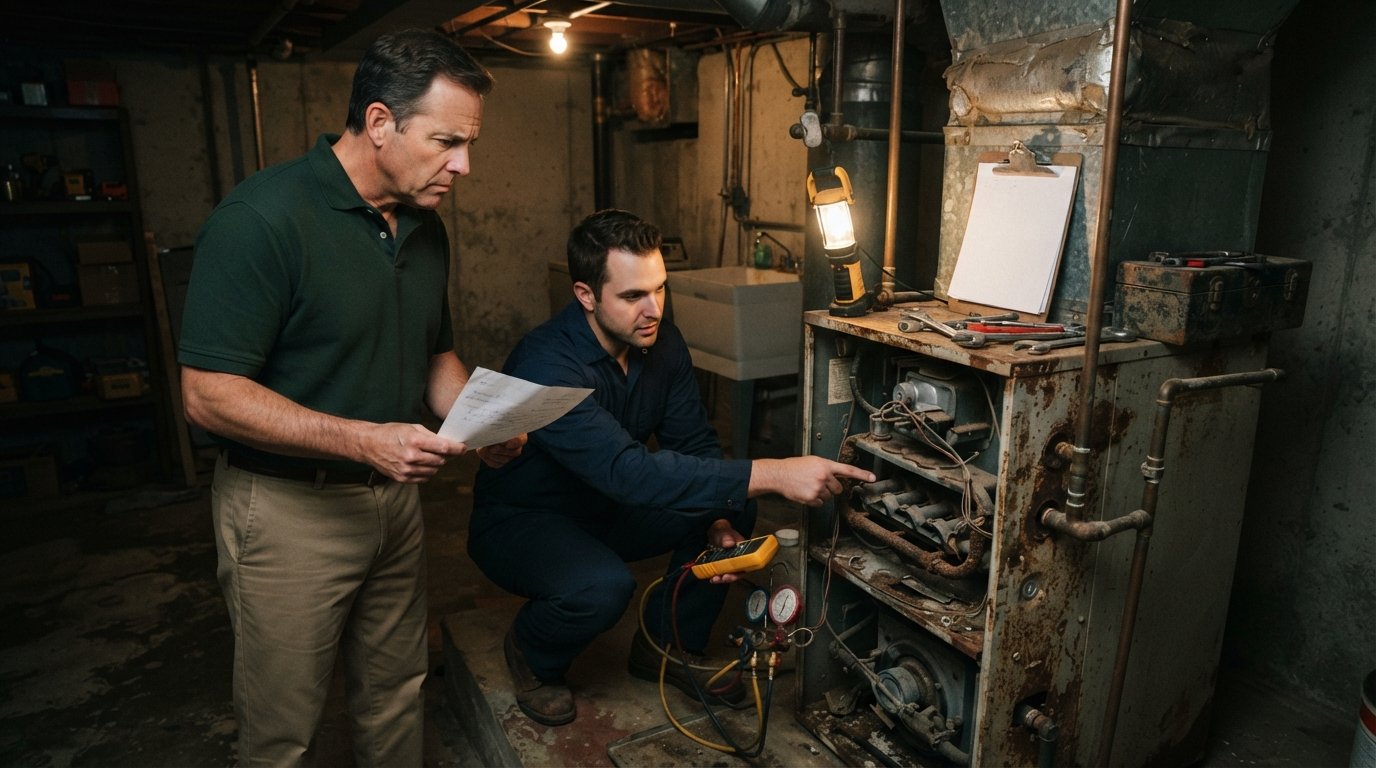
The $5,000 Rule for HVAC Repair vs. Replace
The repair or replace HVAC system 5000 rule can save you thousands. Call (833)-439-3727 to compare local contractor quotes today.
By Adnan Nazir
Learn more about Central Air Conditioning Installation or Replacement for guides, costs, and what to expect.
Compare Central Air Conditioning Installation or Replacement Pros Near You

Enter your ZIP code to compare top-rated local professionals and request free quotes.
Your furnace is making a sound like a trapped animal, or your air conditioner has decided that 85 degrees is the perfect indoor temperature for a July afternoon. The technician delivers the news: you need a repair, and the estimate is $4,800. Your first instinct might be to pay it and move on, but a nagging voice asks whether that money is better spent on a new system. This is exactly the moment the repair or replace HVAC system 5000 rule was designed to address. It is a simple, widely cited guideline that gives homeowners a rational starting point when emotions and summer heat are clouding their judgment. But like any rule of thumb, it has limits, exceptions, and hidden variables that can change the math entirely. Understanding how the $5,000 rule works, when it breaks down, and what other factors should influence your decision will save you from overspending on a dying unit or replacing equipment that still has years of useful life left.
How the $5,000 Rule and the 50% Rule Actually Work
The repair or replace HVAC system 5000 rule is straightforward: if a repair costs more than $5,000, you should seriously consider replacing the entire system instead. The logic is that once a single repair crosses that threshold, you are likely pouring money into a unit that is approaching the end of its service life anyway. A $5,000 repair on a 15-year-old system rarely makes financial sense because the next major failure is probably not far behind. On the other hand, a $5,000 repair on a system that is only six years old and otherwise in good condition might be a reasonable investment, especially if the repair addresses a known defect rather than general wear and tear.
The 50% rule is a companion guideline that many contractors use alongside the $5,000 threshold. It states that if a repair costs more than 50% of the cost of a new system, replacement is the better financial choice. For example, if a new HVAC system costs $8,000 and the repair estimate is $4,500, that repair is 56% of the replacement cost, which pushes the decision toward replacement. The two rules often overlap, but they can produce different answers depending on the numbers involved. The $5,000 rule is an absolute dollar threshold, while the 50% rule is relative to the replacement cost. Using both together gives you a more complete picture than either one alone.
Where the rules break down is in the details. A $5,000 repair on a system that is still under warranty might actually cost you far less out of pocket, which changes the calculus entirely. Similarly, a $4,200 repair on a 20-year-old system that has already had three repairs in the past two years is probably a poor investment even though it falls below the $5,000 threshold. The rules are starting points, not final verdicts. They are most useful when you combine them with information about the system's age, efficiency, refrigerant type, and repair history.
Age, Refrigerant Type, and Efficiency Ratings That Push Toward Replacement
The age of your HVAC system is one of the most important factors in the repair versus replace decision, and it is also one of the easiest to evaluate. Most central air conditioners and heat pumps have a service life of 12 to 15 years, while furnaces can last 15 to 20 years with proper maintenance. If your system is already in that range and needs a repair that approaches the $5,000 threshold, replacement is almost always the smarter move. You are not just paying for the repair; you are paying for a repair on a unit that has already delivered most of its expected value, and you will still face replacement in the near future.
Refrigerant type is another critical variable that many homeowners overlook. Older systems often use R-22 refrigerant, which has been phased out in the United States due to environmental regulations. If your system uses R-22 and develops a leak, the refrigerant itself can cost hundreds of dollars per pound, and supplies are dwindling. A repair that involves recharging an R-22 system can easily approach or exceed the $5,000 threshold, and the underlying leak may not be fully resolved. In this situation, the repair or replace HVAC system 5000 rule points strongly toward replacement because you are fighting a losing battle against refrigerant scarcity and rising costs.
Efficiency ratings also matter, though they are often secondary to age and refrigerant type. If your current system has a SEER rating of 10 or lower and you are facing a major repair, replacing it with a modern high-efficiency unit can reduce your energy bills by 30% to 50% depending on your climate and usage patterns. Those savings can offset a significant portion of the replacement cost over time. The repair or replace decision is not just about the immediate repair bill; it is about the total cost of ownership over the next several years. A repair that keeps an inefficient system running for another three years may cost you more in energy bills than replacing it now with a more efficient model.
Getting Comparable Replacement Quotes from Multiple Contractors
If you have decided that replacement is the likely path, or if you are still on the fence, the next step is to gather multiple quotes from qualified contractors. This is where many homeowners make a costly mistake: they accept the first quote they receive because they are in a hurry or because the contractor seems trustworthy. Getting at least three comparable quotes is essential, not just for price but for understanding the scope of work and the quality of the equipment being proposed. The quotes should be detailed enough that you can compare them line by line, including the model numbers of the equipment, the warranty terms, the scope of installation work, and any additional services like duct cleaning or thermostat replacement.
When you request quotes, be clear about what you want. Ask each contractor to perform a load calculation, which is a room-by-room assessment of your home's heating and cooling needs based on square footage, insulation, window placement, and other factors. A proper load calculation ensures that the new system is sized correctly. An oversized system will short-cycle, which reduces efficiency and wears out components faster, while an undersized system will struggle to keep up on extreme temperature days. If a contractor proposes a system size without performing a load calculation, that is a red flag. You can also use a service like PlanRemodel to find pre-vetted contractors in your area and compare quotes side by side.
Comparing quotes also gives you leverage. When you have three written estimates in hand, you can ask each contractor to explain the differences and justify their pricing. You may find that one contractor is proposing a lower-end model while another is proposing a higher-efficiency unit with a better warranty. The lowest price is not always the best value, especially for a major purchase like an HVAC system that you will rely on for the next 15 years. Look for contractors who are licensed, insured, and willing to provide references. You can learn more about evaluating contractor credentials in our guide on repairing or replacing your water heater, which follows a similar decision framework.
Short-Term Repair Options When Replacement Is Not Affordable Yet
Not every homeowner can afford a full system replacement the moment a major repair is needed. If you are facing a $4,000 repair and a $9,000 replacement, and your budget simply cannot absorb the replacement right now, there are short-term options that can keep your system running while you plan for the larger investment. The key is to be strategic about which repairs you authorize and to avoid throwing money at problems that will not provide meaningful additional life.
One option is to authorize a repair that addresses the immediate failure but defer other non-critical issues. For example, if your system needs a new blower motor and also has a small refrigerant leak, you might repair the motor now and monitor the leak, adding refrigerant as needed until you can replace the system. This approach buys you time but requires discipline: you need to set a firm timeline for replacement and stick to it. Another option is to explore financing options through the contractor or through a home improvement loan. Many HVAC companies offer financing with low monthly payments, which can make replacement more affordable than you expect.
- Prioritize repairs that restore function and safety, such as electrical issues or heat exchanger cracks.
- Defer cosmetic or non-essential repairs that do not affect system operation.
- Ask your contractor about refurbished or scratch-and-dent equipment, which can reduce replacement costs.
- Check whether your utility company offers rebates for high-efficiency replacements.
- Consider a portable or window unit to supplement cooling in one or two rooms if your central system is failing.
It is important to be honest with yourself about the short-term repair path. If your system is 18 years old and has had three repairs in the past two years, a short-term repair is likely just delaying the inevitable and costing you more in the long run. The repair or replace HVAC system 5000 rule exists to prevent that cycle of repeated spending on a dying system. If you find yourself facing a major repair every year, it is time to replace, even if the individual repair costs are below the $5,000 threshold.
What a Load Calculation Should Tell You Before Sizing a New Unit
If you decide to replace your system, the single most important step in the process is the load calculation. A load calculation, often referred to as a Manual J calculation, is a detailed assessment of how much heating and cooling your home actually needs. It takes into account square footage, ceiling height, insulation levels, window type and placement, orientation of the home, local climate data, and even the number of occupants. The goal is to determine the correct system size, measured in BTUs or tons, rather than relying on a rule of thumb like "one ton per 500 square feet," which is imprecise and often leads to oversized systems.
An oversized system is not just a minor inefficiency; it is a recipe for comfort problems and premature failure. When an air conditioner is too large for the space, it cools the air quickly but does not run long enough to remove humidity. The result is a home that feels cold and clammy. The system also short-cycles, turning on and off frequently, which wears out the compressor and other components faster. An undersized system, on the other hand, runs constantly during extreme weather and may never fully reach the desired temperature. Both scenarios are avoidable with a proper load calculation.
When you receive replacement quotes, ask each contractor whether they performed a load calculation and whether they will provide the results. A reputable contractor will be happy to share this information. If a contractor sizes the system based on the old unit's capacity without checking whether the old unit was correctly sized, that is a warning sign. Your home may have changed since the original system was installed: new windows, added insulation, or a room addition can all affect the load. The new system should be sized for your home as it exists today, not as it existed 15 years ago. For more guidance on planning home improvement projects and finding qualified professionals, you can explore the resources at Homes.Contractors.
Ultimately, the repair or replace HVAC system 5000 rule is a useful tool for framing the decision, but it is not a substitute for professional judgment and a clear-eyed assessment of your system's condition. Use the $5,000 threshold and the 50% rule as starting points, then layer in age, refrigerant type, efficiency, repair history, and your own budget and timeline. Gather multiple quotes, insist on a load calculation, and do not let urgency push you into a decision you will regret. Whether you repair or replace, the goal is the same: a comfortable home and a decision you can feel good about for years to come.
Learn more about Central Air Conditioning Installation or Replacement for guides, costs, and what to expect.
Compare Central Air Conditioning Installation or Replacement Pros Near You
Enter your ZIP code to compare top-rated local professionals and request free quotes.