
Repair or Replace Your Water Heater: A Homeowner's Guide
Deciding when to repair versus replace a water heater? Call (833)-439-3727 for expert guidance on costs, lifespan, and finding local pros.
By Chelsea Kris
Learn more about Water Heater Installation or Replacement for guides, costs, and what to expect.
Compare Water Heater Installation or Replacement Pros Near You

Enter your ZIP code to compare top-rated local professionals and request free quotes.
The morning you step into the shower and get nothing but a cold blast is the morning you realize how much your daily routine depends on a functioning water heater. Whether it is a tank that has quietly rusted from the inside or a tankless unit flashing an error code, the immediate question is rarely about brand or efficiency. It is about money and timing. Should you call a technician for a repair, or is it time to admit the unit has reached the end of its life? This decision affects your budget, your home's energy consumption, and the amount of disruption your household will face in the coming days.
Making the wrong call can be expensive. A homeowner who replaces a unit that only needed a $150 heating element wastes thousands of dollars. Conversely, pouring repair money into a twenty-year-old tank that is about to flood the basement is a gamble that rarely pays off. Understanding the specific signals of failure, the age of your equipment, and the true cost of ownership helps you make a rational choice rather than a panicked one.
If you determine that replacement is the smart path, the next step is finding a licensed plumbing contractor without the guesswork. That is where a service like Homes.Contractors becomes useful: it lets you request multiple quotes from pre-vetted local pros so you can compare pricing and credentials side by side before committing.
The Critical Role of Age and Warranty Status
The single most important data point in this decision is the age of your water heater. Most conventional tank water heaters have a lifespan of eight to twelve years. Tankless units can last up to twenty years with proper maintenance, but they are not immortal. If your tank unit is approaching the ten-year mark and develops a major issue, replacement is almost always the more economical choice in the long run.
Checking the age is straightforward. Look for the manufacturer's label on the side of the tank. The serial number usually contains a date code, or there is a separate date of manufacture printed on the label. If you cannot find the date, your warranty paperwork or the installation receipt from the previous owner can provide clues. If the unit is still under warranty, a repair might be partially or fully covered, which shifts the math heavily toward fixing it. However, if the warranty has expired and the unit is old, you are paying out of pocket for a machine that is living on borrowed time.
Warranty terms matter not just for the cost of parts but for the availability of service. Some manufacturers will replace the tank if it leaks within the warranty period, but they rarely cover labor. A six-year warranty on a tank that springs a leak in year five might sound like a win, but the labor cost to swap the tank can still run several hundred dollars. When you factor in that the new tank you receive as a warranty replacement might only be covered for the remainder of the original warranty period (or a very short extension), the value of repairing an old unit drops significantly.
When Repair Is the Logical Choice
Repair is often the right call when the problem is isolated, the unit is relatively young, and the cost of the fix is a small fraction of a new installation. Modern water heaters are simple machines at their core, and many components are designed to be replaced. If the tank itself is intact and not leaking, most other failures are fixable.
Common issues that fall into the "repairable" category include:
- Failed heating elements: In electric models, a burned-out element results in no hot water or insufficient hot water. Replacing an element is a straightforward job for a technician.
- Thermostat malfunctions: If the water is too hot or not hot enough, the thermostat may need adjustment or replacement.
- Pilot light or igniter issues: Gas water heaters rely on a pilot light or electronic ignition. A dirty pilot tube or a faulty thermocouple is a common and inexpensive fix.
- Pressure relief valve leaks: This valve can fail and drip. Replacing it is a safety necessity and a relatively low-cost repair.
- Sediment buildup: If you hear rumbling or popping sounds, sediment has accumulated. Flushing the tank can restore efficiency and extend its life.
In these scenarios, a repair keeps your budget intact and avoids the hassle of a full installation. The key is that the repair cost should not exceed 50% of the price of a new unit, and the unit should be well within its expected lifespan. If you are paying $400 to fix a ten-year-old tank that costs $1,200 to replace, you are halfway to a new heater for a unit that could fail again next month.
It is also worth noting that some repairs are preventative. If you have never flushed your tank, doing so now can add years to its life. Similarly, replacing an anode rod can prevent the tank from rusting from the inside out. These maintenance tasks are not repairs in the traditional sense, but they are investments that keep the unit in the "repair" column rather than the "replace" column.
When Replacement Is the Only Sensible Option
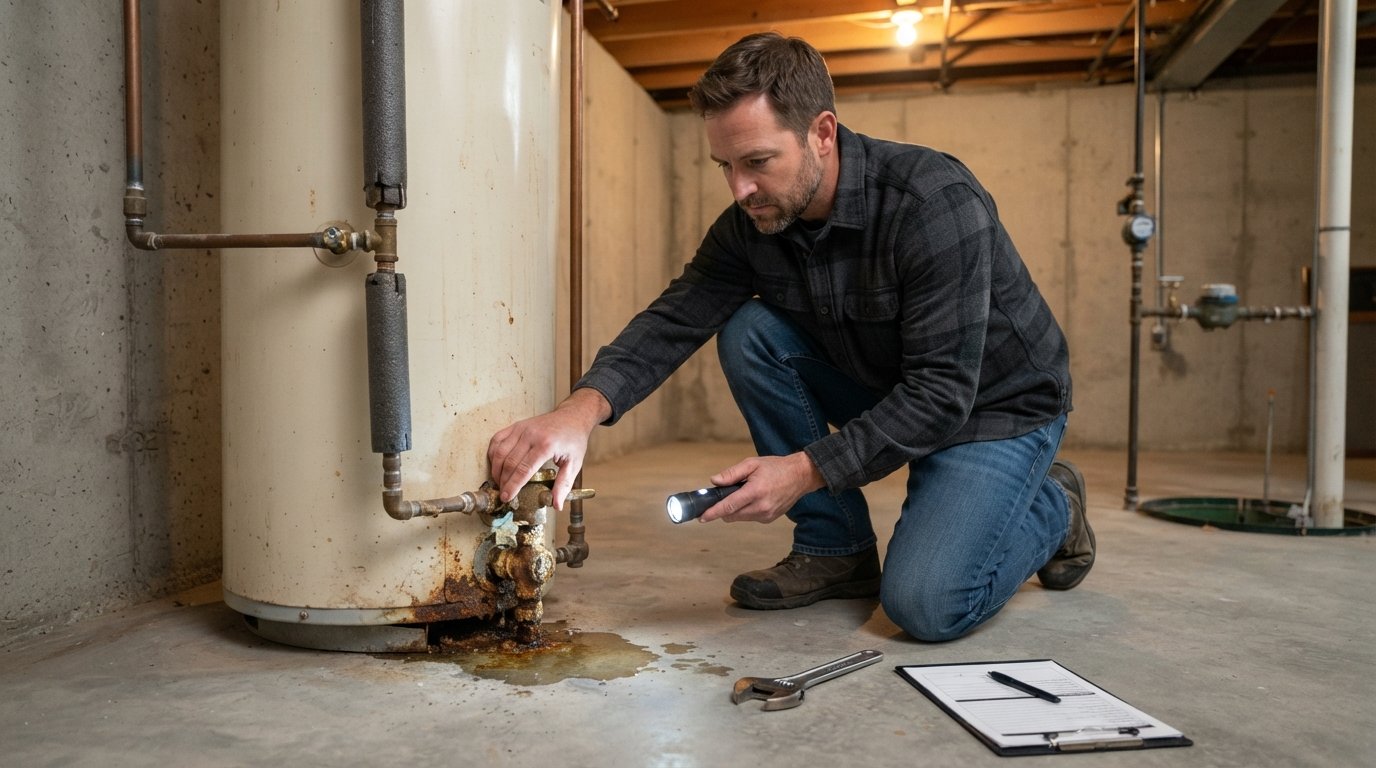
There are clear red flags that signal it is time to stop throwing money at an old unit. The most obvious is a leaking tank. If water is pooling around the base of the heater and it is not from a loose fitting or the pressure relief valve, the internal tank has likely corroded through. This is an irreversible condition. No patch or sealant will reliably fix a rusted-through tank, and ignoring it risks significant water damage to your floors, walls, and belongings.
Another definitive sign is the presence of rusty or metallic-tasting hot water. If you only see rust in the hot water and not the cold, the inside of your tank is corroding. This is a precursor to a leak. While it might be tempting to wait, the tank could give way at any time, often when you are away from home or asleep.
Beyond leaks and rust, consider these factors that tilt the scale toward replacement:
- Frequent breakdowns: If you have called a technician twice in the last two years for different issues, the unit is becoming unreliable.
- Age over ten years: Even if the current issue is fixable, the next one is likely just around the corner.
- Inefficiency: Older units operate at lower efficiency ratings. Replacing a ten-year-old unit with a new ENERGY STAR model can reduce your utility bills.
- Insufficient capacity: If your household has grown and you constantly run out of hot water, a repair will not solve the underlying problem of an undersized tank.
- Code violations: If the unit is improperly vented or lacks a required expansion tank, bringing it up to code can be costly.
When you replace, you also gain a new warranty, a clean slate, and often a more efficient machine. The decision becomes easier when you consider the total cost of ownership. A new unit might cost $1,200 installed, but it will likely last a decade with minimal maintenance. An old unit that needs a $300 repair today might need another $300 repair in six months, and then a $1,500 replacement when it finally fails. The repair path can be a series of escalating expenses.
Comparing the True Costs: Repair Versus Replace
To make a rational decision, you need to compare the immediate out-of-pocket cost of a repair against the long-term value of a replacement. This is not just about the price tag on the service call; it is about the expected remaining life of the unit and the risk of collateral damage.
Consider a scenario where you have a nine-year-old gas water heater with a faulty thermocouple. The repair costs $200. The unit has a life expectancy of twelve years. You are essentially buying three more years of service for $200. That is a reasonable deal if the tank is in good condition. However, if that same unit has a leaking tank, the repair is impossible. A new unit is the only option.
Now consider a five-year-old electric heater with a burned-out element. The repair costs $250. The unit has seven to ten years of life left. Replacing it would cost $1,100. In this case, repairing is clearly the better financial move. You are preserving a relatively new asset for a fraction of the replacement cost.
The calculation becomes murkier when the repair cost approaches half the replacement cost. If a repair is $600 and a new unit is $1,200, you are paying 50% of the replacement cost for a unit that is already halfway through its life. In this situation, many homeowners choose to replace, because the marginal cost of getting a brand-new unit with a full warranty is small compared to the risk of another failure.
It is also important to factor in the cost of doing nothing. A leaking tank can cause thousands of dollars in water damage. If your water heater is located in an attic or on a second floor, the risk is even higher. In those cases, replacing a unit that shows any sign of tank failure is not just a maintenance decision; it is a risk management decision.
Efficiency and Capacity: The Upgrade Opportunity
Sometimes the decision to replace is driven not by failure but by a desire to upgrade. If your current unit is working but you are constantly running out of hot water, or if your utility bills are climbing, a new unit can solve multiple problems at once. This is particularly true when you compare older tank models to modern tankless or high-efficiency condensing units.
Tankless water heaters, for example, heat water on demand rather than storing it in a tank. They are more efficient, take up less space, and provide endless hot water. However, they have higher upfront costs and require proper venting and gas line sizing. If you are already facing a major repair on an old tank, the incremental cost to upgrade to tankless might be worth it for the long-term savings and comfort.
Similarly, if you are remodeling a bathroom or adding a new shower, your existing water heater might not be able to keep up with the increased demand. In that case, replacing the unit with a larger or more powerful model is part of the renovation project, not just a repair. When planning a larger renovation, it helps to approach the project with a clear decision framework. For example, in our guide on asphalt driveway repair versus replacement, we explain how to weigh repair costs against replacement value, and the same logic applies to major home systems like water heaters.
Energy efficiency is another factor. Old water heaters can lose heat through the tank walls, especially if they are not insulated. New units often come with better insulation and more precise controls. While the savings might seem small month to month, over the life of the unit they can add up. If you plan to stay in your home for the long term, investing in a more efficient unit can pay off.
DIY Versus Professional Installation and Repair
Water heaters involve gas, electricity, and water under pressure. While some homeowners are comfortable replacing a heating element or flushing a tank, major repairs and installations are best left to licensed professionals. A mistake with a gas connection can lead to carbon monoxide poisoning. An electrical error can cause a fire. A poorly installed tank can leak and cause structural damage.
Moreover, many manufacturers require professional installation to validate the warranty. If you install a new water heater yourself and it fails, you may find that the warranty is void. Similarly, if you attempt a repair and cause further damage, you will be responsible for the entire replacement cost.
Hiring a professional also ensures that the job is done to code. Building codes change over time, and a new water heater may require an expansion tank, a pan with a drain, or specific venting configurations. A licensed plumber will know these requirements and can pull the necessary permits. This is not just about passing inspection; it is about safety and insurance. If a fire or flood occurs due to an improper installation, your homeowner's insurance might deny the claim.
When you hire a pro, you also get a professional opinion on whether to repair or replace. A good technician will not try to sell you a new unit if a repair is the better option. They will explain the pros and cons and give you a written estimate. This is where comparing multiple quotes can be valuable. Different contractors may have different recommendations based on their experience and the specific condition of your unit.
Making the Final Call
The decision to repair or replace a water heater comes down to a balance of age, condition, cost, and risk. If your unit is under eight years old and the problem is a single component like a thermostat or heating element, repair is usually the smart choice. If your unit is over ten years old, leaking, or rusting, replacement is the only reliable option. If you are somewhere in the middle, let the 50% rule guide you: if the repair costs more than half the price of a new unit, replace it.
Do not forget to consider your household's needs. A growing family or a home renovation might demand a larger or more efficient unit. In that case, replacement is an opportunity to upgrade rather than just a response to failure. Whatever you decide, act quickly. A failing water heater can cause significant damage if ignored, and a cold shower is the least of your worries when water is dripping through the ceiling.
For homeowners who need to find a qualified plumber, requesting quotes from multiple contractors is the best way to ensure a fair price and quality work. Whether you are repairing a minor issue or replacing a major appliance, having a few estimates in hand gives you the confidence to move forward. PlanRemodel
Learn more about Water Heater Installation or Replacement for guides, costs, and what to expect.
Compare Water Heater Installation or Replacement Pros Near You
Enter your ZIP code to compare top-rated local professionals and request free quotes.