
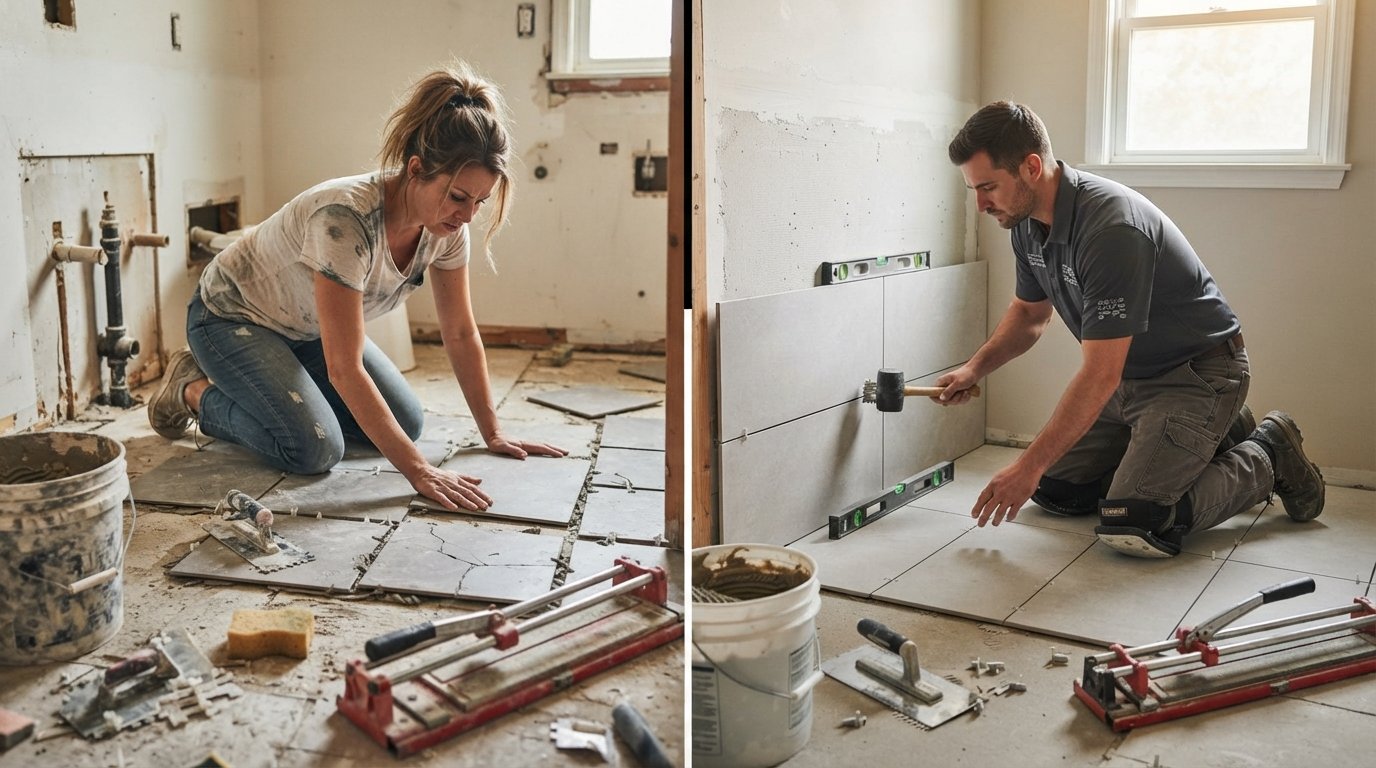
DIY versus Hiring a Pro for Tile Installation
DIY versus hiring a pro for tile installation: compare costs, skills, and risks. Learn when to save money and when to call a professional for lasting results.
By Chelsea Kris
Learn more about Tile Installation and Replacement for guides, costs, and what to expect.
Compare Tile Installation and Replacement Pros Near You

Enter your ZIP code to compare top-rated local professionals and request free quotes.
Tile installation looks deceptively simple in short video clips: spread thinset, set the tile, grout, and done. In reality, it is a precise trade that involves substrate preparation, waterproofing, layout planning, cutting around obstacles, and managing heavy materials. The choice between DIY versus hiring a pro for tile installation affects your budget, timeline, and the long-term durability of your floor or wall. A poorly installed tile job can lead to cracked tiles, uneven surfaces, mold growth, and costly repairs. A professional installation protects your investment and often adds value to your home. This guide breaks down the real costs, skill requirements, and risk factors so you can decide which path fits your situation.
What Tile Installation Actually Involves
Before you decide to tackle tile yourself, you need to understand the full scope of the work. Tile installation is not just laying tiles on a surface. It starts with evaluating the substrate, which is the surface beneath the tile. For floors, that might be a concrete slab or a plywood subfloor. For walls, it could be cement backer board or drywall. The substrate must be clean, level, and structurally sound. If it flexes or has high moisture content, your tile will crack or debond.
Next comes layout planning. You need to find the center of the room, account for doorways and corners, and decide on a grout line width. A common mistake is starting from a wall that is not square, which causes tiles to drift and creates ugly cuts at the opposite end. Professional installers use lasers and chalk lines to ensure symmetry and balanced cuts. They also plan for expansion joints, which allow the tile to move with temperature changes without cracking.
Waterproofing is another critical step, especially in bathrooms, kitchens, and laundry rooms. Cement backer board alone is not waterproof; you need a waterproof membrane or coating. Skipping this step can lead to water damage, mold, and structural rot. Finally, cutting tile requires specialized tools: a wet saw for straight cuts, a tile nipper for curves, and a diamond hole saw for pipes. Grouting and sealing complete the job, but only after the thinset has cured properly.
Given all these steps, it is clear why tile installation is a skilled trade. The question is whether you have the time, tools, and patience to learn and execute each phase correctly. If you are considering a professional, you can find reliable tile installation contractors in your area through a directory that pre-vets local pros. That said, many homeowners successfully complete DIY tile projects with careful planning.
Cost Comparison: DIY versus Hiring a Pro for Tile Installation
Cost is often the deciding factor. DIY tile installation can save you money on labor, but it requires an upfront investment in tools and materials. Professional installation costs more per square foot, but it includes labor, tools, and expertise. Let us break down the numbers.
For a typical 100-square-foot bathroom floor, a DIY project might cost $500 to $1,000 in materials: tile, thinset, grout, backer board, waterproofing, and spacers. If you do not own a wet saw, you can rent one for about $50 to $100 per day, or buy a basic model for $200 to $400. You will also need a drill with a mixing paddle, a notched trowel, a level, and a grout float. These tools can add $150 to $300 if you do not already have them. So your total DIY cost could be $700 to $1,400.
A professional installer typically charges $5 to $15 per square foot for labor, depending on the complexity and your location. For 100 square feet, that is $500 to $1,500 in labor alone. Materials are often marked up slightly, or you can supply your own. So a pro job might cost $1,200 to $2,500 total. The difference is roughly $500 to $1,100. However, that difference buys you speed, precision, and a warranty. If you factor in the value of your time (say, 20 to 30 hours for a DIY job), the effective hourly savings might be $20 to $50 per hour. That is reasonable for some, but not for everyone.
There are also hidden costs to DIY mistakes. If you crack tiles, you may need to buy more. If you install incorrectly and water damages the subfloor, repairs can cost thousands. A professional job avoids these risks. When you request quotes from multiple contractors, you can compare prices and scope. Using a platform like FreeQuotes.Contractors can help you get free estimates from local pros, so you can see the real market rate for your project.
Here is a quick breakdown of the cost factors to consider:
- Materials: Tile, thinset, grout, backer board, waterproofing, spacers, and sealant. DIY and pro both pay for these, but pros may get discounts.
- Tools: Wet saw, trowels, levels, mixers, and safety gear. DIY requires purchase or rental; pros already own them.
- Labor: The biggest variable. DIY is free (except your time); pro labor is $5 to $15 per square foot.
- Time: DIY can take weekends or weeks; pros finish in days.
- Risk: DIY mistakes can lead to costly repairs; pro work often comes with a warranty.
When you weigh these factors, DIY is cheaper if you have the skills and tools. If not, hiring a pro may be more cost-effective in the long run. Always get at least three quotes to understand the range.
Skill and Experience: Can You Really Do It Yourself?
Tile installation requires a mix of physical skill and technical knowledge. You need to be comfortable using power tools, mixing thinset to the right consistency, and applying it evenly. You also need an eye for detail: uneven grout lines, lippage (tiles that are not flush), and poor cuts are obvious and permanent. If you have never tiled before, start with a small project like a backsplash. A floor or shower is much more challenging.
Waterproofing is where many DIYers fail. Showers require a sloped pan, a waterproof membrane, and a leak test. If you get this wrong, water will seep into the walls and cause mold. Similarly, floors over wood subfloors need an uncoupling membrane to prevent cracks from movement. These are not intuitive steps; they require knowledge of building codes and best practices.
That said, DIY tile installation is doable for a handy homeowner. You can learn from books, videos, and workshops. The key is to practice on a small area and be honest about your limits. If your project involves complex patterns, large-format tiles, or a wet area, consider hiring a pro. The cost of fixing a failed DIY job is often higher than paying for professional installation upfront.
Here are signs you should hire a pro:
- Your project is in a wet area (shower, bathroom floor, kitchen backsplash near a sink).
- You are using large-format tiles (over 12x12 inches) or natural stone, which require special handling.
- Your substrate is uneven, damaged, or requires repair.
- You do not own or know how to use a wet saw and other tile tools.
- You have a tight timeline or cannot afford downtime.
If none of these apply, and you are willing to invest time in learning, DIY can be a rewarding project. Just remember that tile is a permanent finish; mistakes are costly to undo.
Time and Convenience: The Hidden Factor
Time is money, and tile installation takes time. A professional crew can tile a 100-square-foot floor in one or two days. A DIYer might take a week or more, especially if they are learning as they go. During that time, your bathroom or kitchen may be unusable. If you have a busy household, that disruption can be a major drawback.
Professionals also work efficiently because they have done it many times. They know how to cut around toilets, outlets, and door jambs without wasting materials. They can anticipate problems and adjust. For DIYers, each step is a learning curve. You might spend hours watching videos and then still make mistakes. If your time is valuable, hiring a pro frees you to focus on work or family.
Another consideration is cleanup. Tile installation creates dust, debris, and heavy trash. Pros haul away old materials and leave the site clean. DIYers must dispose of everything themselves, which can add to the cost and effort. When you factor in tool rental, material pickups, and cleanup, the convenience of a pro becomes more attractive.
However, if you enjoy DIY projects and have the time, the satisfaction of completing a tile job yourself is significant. You also gain skills for future projects. The decision hinges on how you value your time and the importance of a flawless finish.
When DIY Makes Sense
DIY tile installation is a good option in certain scenarios. If you are tiling a small, dry area like a backsplash or a laundry room floor, the risk is lower. These areas are less prone to water damage, and mistakes are less costly. If you have prior tiling experience or are willing to practice, you can save money and learn a new skill.
DIY also makes sense if you are on a tight budget and have more time than money. For example, a young homeowner might choose to tile a basement floor themselves to save for other upgrades. In this case, using a simple pattern and ceramic tiles can yield good results with basic tools. Just be sure to follow best practices for substrate preparation and waterproofing where needed.
Another scenario is when you are doing a temporary fix or a low-traffic area. If you plan to remodel again in a few years, a DIY job might be acceptable. But for permanent, high-traffic areas, professional installation is usually better. Always consider the resale value of your home; buyers notice poor tile work.
Before starting, gather quotes from pros anyway. Knowing the professional price gives you a baseline to compare your DIY savings. You can request multiple free quotes through a service like FreeQuotes.Contractors to see what local installers charge. If the quotes are surprisingly affordable, you might decide the savings are not worth the effort.
When Hiring a Pro Is the Smart Choice
For most homeowners, hiring a pro is the smarter choice for tile installation, especially for floors and showers. The complexity of waterproofing, substrate preparation, and cutting makes it easy to make mistakes that lead to costly repairs. A professional installer has insurance, a warranty, and a reputation to protect. They will complete the job quickly and correctly, and you can hold them accountable if something goes wrong.
Hiring a pro is also essential if your project requires permits or inspections. Many municipalities require permits for bathroom remodels, and a licensed contractor will know how to navigate the process. If you DIY without a permit, you could face fines or have to redo the work. Additionally, if you sell your home, unpermitted work can be a red flag for buyers and inspectors.
Finally, consider the value of your home. Tile is a visible, permanent feature. A professional installation enhances the look and value of your property. Poor DIY work can detract from it. If you are remodeling to sell, invest in professional installation to maximize your return on investment. Even if you are staying, a beautiful, durable tile job brings daily satisfaction.
To find a qualified pro, ask for referrals, check licenses, and read reviews. You can also use online directories to compare contractors. Always get at least three written estimates and ask for references. A good contractor will be happy to provide them. With the right pro, your tile project will be stress-free and long-lasting.
In the end, the decision between DIY versus hiring a pro for tile installation comes down to your skills, budget, timeline, and risk tolerance. If you are confident, have the tools, and the area is simple, DIY can save money. For complex or wet areas, hiring a pro is worth the investment. Either way, do your research and plan carefully. Your home deserves a beautiful, durable tile installation.
Learn more about Tile Installation and Replacement for guides, costs, and what to expect.
Compare Tile Installation and Replacement Pros Near You
Enter your ZIP code to compare top-rated local professionals and request free quotes.