
Refinishing Hardwood Floors Versus Replacing Them
Refinishing hardwood floors versus replacing them comes down to condition, thickness, and budget. Learn which option saves money and which lasts longer.
By Adnan Nazir
Learn more about Hardwood Floor Refinishing for guides, costs, and what to expect.
Compare Hardwood Floor Refinishing Pros Near You

Enter your ZIP code to compare top-rated local professionals and request free quotes.
Your hardwood floors have seen better days. The finish is worn thin in the hallway, there is a dark stain near the kitchen where a pipe leaked years ago, and every piece of furniture seems to have left its mark. Now you are staring at two very different paths: refinishing hardwood floors versus replacing them. One restores the surface you already have. The other tears it out and starts over. The gap between those two options can be thousands of dollars, several weeks of disruption, and a permanent change to how your home looks and feels. Choosing wrong is expensive. Choosing right starts with understanding exactly what each process involves, what it costs, and which one your specific floor actually needs.
What Refinishing Actually Involves
Refinishing is a restoration process. It keeps the existing wood planks and removes only the damaged top layer, then applies a fresh protective finish. Think of it like resurfacing a driveway rather than repouring the concrete. The structural wood stays in place. What changes is the surface you see and walk on.
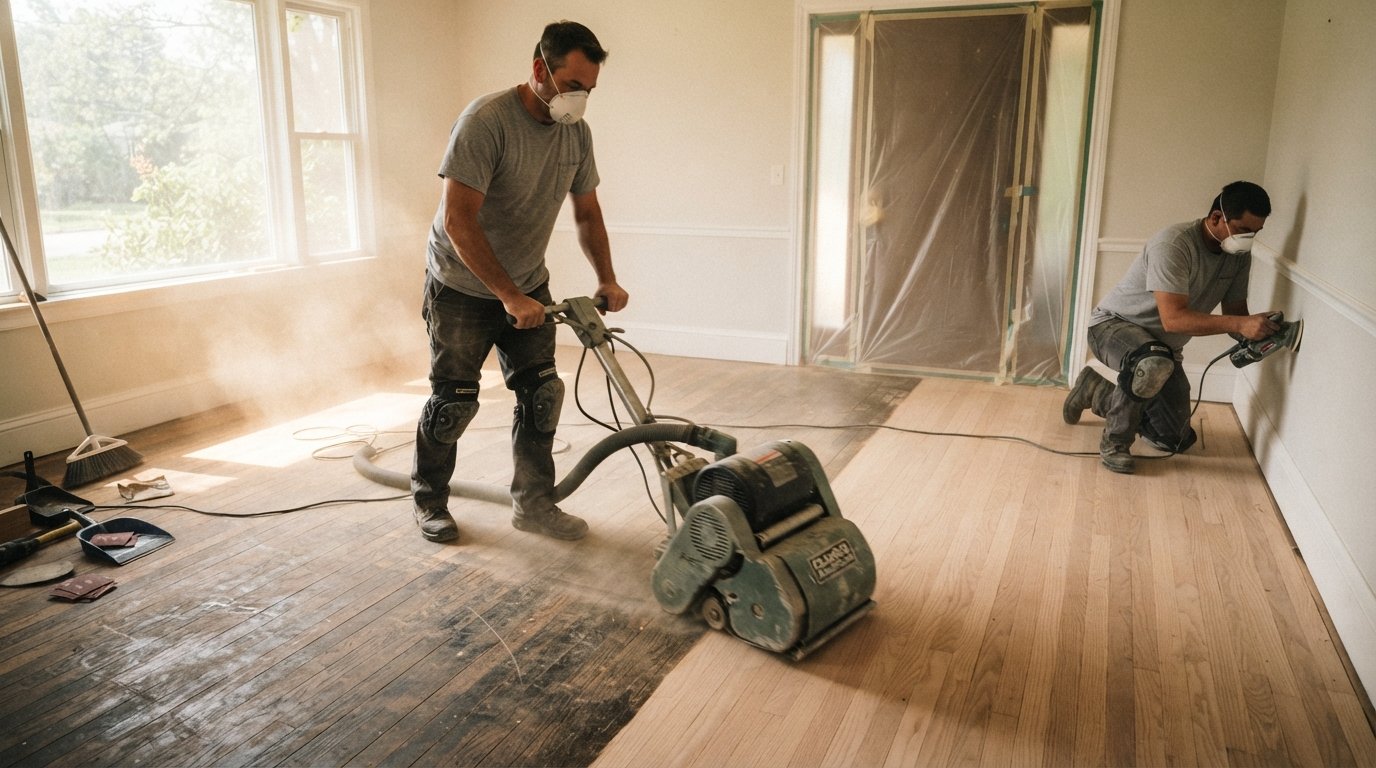
A professional refinishing job typically follows a clear sequence. First, the crew preps the space by removing furniture, covering vents, and taping off doorways to contain dust. Next comes sanding. Most floors get three passes with progressively finer grits, starting coarse to strip old finish and level minor imperfections, then finer to smooth the grain. Edges and corners get hand-scraped or sanded with specialized tools. After sanding, the floor is vacuumed and wiped to remove every trace of dust, because trapped dust ruins a new finish. Then stain goes down if you want a color change. Finally, two to three coats of polyurethane, oil-based or water-based, are applied with light sanding between coats.
The whole process usually takes three to five days for an average room, though you cannot walk on the floor for at least 24 hours after the final coat and should wait several days before moving furniture back. Refinishing works best when the wood is structurally sound and thick enough to survive another sanding. Solid hardwood floors can typically be refinished four to six times over their lifetime. Engineered floors with a thin veneer often cannot be sanded at all, or only once.
What Replacement Involves
Replacement means removing the existing flooring entirely and installing new material. This can mean tearing out solid hardwood and putting down new solid hardwood, or switching to engineered wood, luxury vinyl plank, or another option. The scope is much larger. Demolition alone generates significant debris. Subfloor inspection and repair often follow, because you cannot install new flooring over a damaged or uneven subfloor. Then installation begins, followed by finishing if you chose unfinished wood.
Timelines stretch accordingly. A single room might take one to two weeks from demolition to final coat. Multiple rooms or an entire floor can run three to six weeks depending on material availability and drying times. Replacement makes sense when the existing floor is beyond saving: water damage that has warped or rotted planks, widespread pet stains that have penetrated deep into the wood, structural damage from pests, or simply a floor that has already been sanded too many times to handle another pass. It is also the right call when you want a different material entirely, such as switching from hardwood to a waterproof luxury vinyl in a bathroom or basement.
Cost Comparison: The Numbers That Matter
Cost is usually the first question homeowners ask, and for good reason. The price gap between refinishing and replacing is substantial, but it depends heavily on square footage, wood species, finish type, and your region. National averages give a useful starting point, though local labor rates and material costs will shift the final number.
- Refinishing: Typically $3 to $8 per square foot, or roughly $1,000 to $3,000 for an average 300-square-foot room.
- Replacing with solid hardwood: Typically $8 to $15 per square foot installed, or $2,400 to $4,500 for the same 300-square-foot room.
- Replacing with engineered wood or luxury vinyl: Typically $5 to $12 per square foot, depending on material quality and subfloor prep needs.
- Hidden costs: Replacement often adds subfloor repair, trim replacement, door adjustments, and disposal fees that can push the total 20 to 40 percent higher than the initial estimate.
Those numbers tell a clear story. Refinishing almost always costs less upfront. But cost alone is not the deciding factor. A refinish on a floor that is already unstable is money wasted. A replacement on a floor that only needed a fresh coat is money overspent. The right question is not which is cheaper, but which is appropriate for the condition of your specific floor.
Getting accurate local pricing matters more than national averages. A marketplace like FreeQuotes.Contractors lets you request multiple quotes from pre-vetted local flooring professionals, so you can compare real numbers for your project instead of guessing. That kind of side-by-side comparison is the fastest way to know whether refinishing or replacing makes financial sense in your market.
How to Assess Whether Your Floor Can Be Refinished
Before you call anyone, you can do a basic assessment yourself. The goal is to determine whether the wood has enough thickness and structural integrity to survive sanding. Here is a practical checklist.
- Check the thickness. Find a floor vent or a transition strip where you can see the cross-section of a plank. If the wear layer (the wood above the tongue-and-groove joint) is less than about 1/16 inch, sanding may expose the joint and ruin the floor.
- Look for deep damage. Surface scratches and worn finish are refinishable. Deep gouges, pet stains that have blackened the wood, or water stains that have penetrated through the plank usually are not.
- Test for moisture or warping. Cupping, crowning, or planks that move underfoot suggest moisture problems. Sanding a warped floor will not fix the underlying issue.
- Count previous sandings. If you know the floor has been refinished three or more times, there may not be enough material left for another pass.
- Consider the subfloor. Squeaks, soft spots, or visible gaps between planks can indicate subfloor problems that need attention regardless of which option you choose.
If most of these checks come back clean, refinishing is likely viable. If two or more raise red flags, replacement becomes the more sensible long-term investment. A qualified flooring contractor can confirm your assessment with an on-site inspection, which is why getting at least two or three professional opinions is worth the effort.
When Refinishing Is the Smarter Choice
Refinishing wins in several common scenarios. If your floors are structurally sound but simply look tired, dull, or scratched, refinishing restores them at a fraction of replacement cost. If you love the existing wood species and width, refinishing preserves that character. Older homes often have wider planks or rare wood varieties that would be expensive or impossible to match with new material. Refinishing also lets you change the color without changing the floor, so you can go darker, lighter, or pick up a trendier tone without demolition.
There is also a practical disruption argument. Refinishing keeps your home livable faster. You are not waiting on material orders, demolition, or subfloor repairs. For homeowners who need to stay in the house during the project, refinishing is far less disruptive than a full tear-out. And from a value standpoint, a well-refinished floor delivers one of the highest returns on investment of any interior project, often recouping a significant portion of its cost at resale.
When Replacement Is the Smarter Choice
Replacement becomes the better option when the floor has problems that refinishing cannot solve. Water damage that has caused planks to swell, cup, or rot is a classic example. Sanding a swollen plank does not flatten it; it just creates a thinner, still-swollen plank. Pet stains that have soaked through to the subfloor leave permanent dark marks that no amount of sanding will remove. Pest damage, such as termite galleries or powderpost beetle holes, compromises structural integrity.
Replacement is also the right move when you want a material change. If you are converting a room to a wet environment, like a bathroom or laundry area, hardwood may not be the best choice regardless of condition. Waterproof luxury vinyl or tile makes more sense. Similarly, if the existing floor is a thin engineered product with no refinishable wear layer, replacement is your only path to a fresh look. Finally, if the floor has already been refinished to its limit and is showing bare wood at the tongue joints, replacement is inevitable.
One more scenario deserves mention: major renovations. If you are already gutting a kitchen or adding on to the house, replacing flooring while walls are open and subfloors are accessible is far more efficient than refinishing now and replacing later. The marginal cost of replacement during a larger project is often lower than doing it as a standalone job down the road.
Making the Decision: A Practical Framework
Weighing refinishing hardwood floors versus replacing them comes down to four factors: condition, thickness, budget, and timeline. Start with condition. If the damage is surface-level, refinish. If it is structural or has penetrated the wood, replace. Next, check thickness. If the wear layer is too thin, refinishing is off the table regardless of budget. Then consider your budget honestly. Refinishing is cheaper, but only if it will actually last. A cheap refinish on a failing floor is not a savings; it is a delay. Finally, think about timeline. If you need the room back quickly, refinishing is faster. If you can absorb a longer project and want a guaranteed fresh start, replacement may be worth the wait.
It also helps to get professional eyes on the floor before committing. A contractor can measure wear layers, check for moisture issues, and give you a realistic estimate for both options. That is where a directory like Homes.Contractors becomes useful. It connects homeowners with pre-vetted local contractors across flooring, remodeling, and repair services, and it lets you request multiple free quotes without any obligation. You can compare bids side by side, ask questions, and verify credentials before signing anything. The site does not perform the work itself, but it streamlines the process of finding qualified professionals in your area.
Questions to Ask Before You Hire Anyone
Whichever path you choose, the quality of the installation or refinishing depends heavily on who does the work. Ask every contractor the same set of questions so you can compare apples to apples. How many years have you been refinishing or installing hardwood? Can you provide references from similar projects in the last year? Are you licensed and insured, and can I see proof? What type of finish do you use, and how many coats are included? What is your dust containment process? What does the warranty cover, and for how long? Do you handle subfloor repair, or is that a separate line item? Getting clear answers to these questions protects you from surprises and helps you identify the professionals who actually know their craft.
It is also wise to verify credentials independently. Licensing requirements vary by state, and insurance coverage should be confirmed directly with the provider. Homes.Contractors does not warrant or guarantee any work performed, so due diligence on your part remains essential. A few minutes of verification can save you thousands in corrective work later.
Refinishing hardwood floors versus replacing them is not a decision to rush. Both options have clear strengths: refinishing preserves character at a lower cost, while replacement delivers a guaranteed fresh start and opens the door to new materials. The right choice depends on what your floor can handle and what you want the room to become. Get a professional assessment, request multiple quotes, verify your contractors, and then commit with confidence. Your floors will reward you for the next decade or more.