
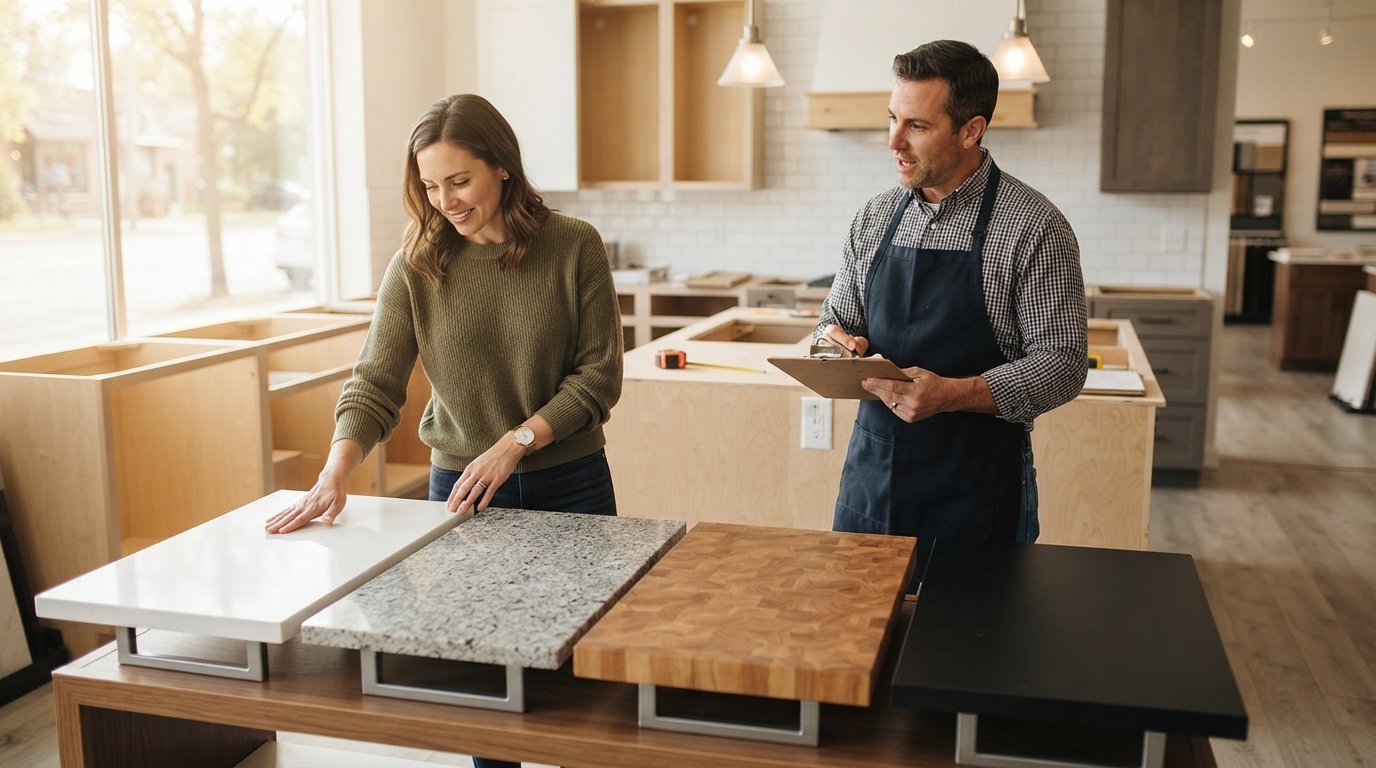
How to Choose a Kitchen Countertop Material for Durability and Budget
Compare durability and cost across quartz, granite, laminate, and more. Pick the right kitchen countertop for your budget without overpaying.
By Danica Leslie
Learn more about Countertop Installation for guides, costs, and what to expect.
Compare Countertop Installation Pros Near You

Enter your ZIP code to compare top-rated local professionals and request free quotes.
A kitchen remodel can feel like a thousand decisions stacked on top of each other, and few choices carry as much weight as the countertop. It is the surface you chop on, roll dough across, set hot pans on, and stare at every morning while waiting for coffee. It also represents one of the largest single line items in a typical kitchen budget, often rivaling the cost of cabinets. Get it right, and you enjoy a durable, beautiful workspace for decades. Get it wrong, and you live with stains, chips, or a surface that never quite felt worth the money. The goal of this guide is simple: help you choose a kitchen countertop material that balances real-world durability with the budget you actually have, without drowning in jargon or sales pressure.
Before comparing quartz to granite or laminate to butcher block, it helps to understand how countertop costs break down. Material is only part of the equation. Fabrication, edge profiles, cutouts for sinks and cooktops, and installation labor all add up quickly. If you want a clearer picture of how labor and materials split your total project cost, the guide on labor cost vs material cost explains the ratios homeowners should expect. That context matters because a material that looks affordable per square foot can become expensive once cutting, polishing, and installation are factored in.
This article walks through the durability traits that actually matter, then matches those traits to budget tiers. You will see how to compare materials on equal footing, which questions to ask contractors, and where it makes sense to splurge versus save. By the end, you should be able to walk into a showroom or a contractor conversation with a clear shortlist and a realistic number in mind.
Start With How You Actually Use Your Kitchen
Durability is not a single score. It is a collection of behaviors: resistance to scratches, heat, stains, impact, and moisture. A material that excels at one can fail at another. Granite, for example, shrugs off heat and scratches but can chip at a sharp corner and needs periodic sealing. Quartz resists stains and scratches beautifully but can be damaged by a hot skillet set directly on the surface. Solid surface materials are easy to repair but scratch more easily than stone.
That is why the first step is honest self-assessment. A household that cooks three meals a day from scratch, uses cast iron, and has young children will stress a countertop very differently than a couple who mostly reheats takeout. If you bake frequently, you may want a surface that tolerates flour, dough, and direct rolling. If you entertain often, stain resistance and easy cleanup move up the priority list. If you are remodeling to sell within a few years, resale appeal and perceived value may matter more than ultimate toughness.
Once you know your usage patterns, you can rank the durability traits that matter most. A useful way to frame this is to score each material against the five common failure modes homeowners report:
- Scratches and cuts from knives, appliances, or dragged dishes.
- Heat damage from hot pans, baking sheets, or slow cookers.
- Stains from wine, oil, turmeric, coffee, or acidic foods.
- Impact damage such as chips, cracks, or broken corners.
- Moisture damage, including swelling, warping, or mold at seams.
Write down which two or three of these would bother you most. That short list becomes your filter. A material that scores poorly on your top priority should be eliminated early, no matter how good it looks in a showroom. This approach also gives you language to use with contractors: instead of asking what is best, you can ask how each option performs against your specific concerns.
Match Materials to Budget Tiers
Countertop materials fall into rough budget bands, though prices vary by region, thickness, edge profile, and fabrication complexity. The bands below reflect typical installed costs in the United States, not just the slab or sheet price. Always request an installed quote, because a low material price with high fabrication fees can end up costing more than a mid-range option that installs cleanly.
The budget tier, roughly $20 to $50 per square foot installed, includes laminate, ceramic tile, and some butcher block. Laminate has improved dramatically in recent years, with textured finishes that mimic stone convincingly. It resists stains and is easy to clean, but it can scorch under hot pans and is difficult to repair if cut. Ceramic tile is inexpensive and heat-resistant, but grout lines collect crumbs and need regular sealing. Butcher block is warm and knife-friendly but requires oiling and can be damaged by standing water.
The mid-range tier, roughly $50 to $100 per square foot installed, includes solid surface materials, mid-grade quartz, and some granite. Solid surface, such as Corian, is non-porous and can be sanded to remove scratches, which makes it a strong choice for busy families. Quartz offers excellent stain and scratch resistance with minimal maintenance. Granite in this range may have more visible pattern variation or require more seams, but it delivers natural stone character and heat resistance.
The premium tier, roughly $100 to $200 or more per square foot installed, includes high-end quartz, exotic granite and marble, quartzite, and sintered surfaces such as Dekton. These materials offer top-tier performance in specific categories: quartzite and sintered surfaces resist heat and scratches exceptionally well, while marble offers unmatched beauty but stains and etches easily. Premium pricing often reflects rarity, bookmatched patterns, and complex fabrication rather than pure durability.
Two practical notes apply across all tiers. First, the sink and cooktop cutouts, edge profiles, and backsplash choices can add hundreds of dollars regardless of material. Second, remnant slabs and off-cut pieces can deliver a premium look at a mid-range price if your layout is small or you are willing to work with limited dimensions. Ask contractors whether remnants are available before you settle on a standard option.
Compare Durability and Maintenance Side by Side
Price alone does not tell you whether a countertop is a good deal. A cheap surface that needs replacement in five years costs more over time than a mid-range surface that lasts twenty. The table below summarizes how common materials perform against the durability traits that matter most, along with the maintenance each requires.
Use this comparison as a starting point, then verify with local contractors, because climate, humidity, and installation quality affect performance. In humid regions, for example, wood countertops need more frequent sealing to prevent warping. In sunny kitchens, some laminates and solid surfaces may fade over time if exposed to direct sunlight.
Here is a quick reference for the most common options:
- Laminate: Low cost, stain-resistant, but susceptible to heat and cuts. Best for rentals, budget flips, and low-use kitchens.
- Butcher block: Warm, knife-friendly, repairable by sanding, but requires oiling and careful moisture management.
- Ceramic tile: Very heat-resistant and inexpensive, but grout maintenance and chipping are common complaints.
- Solid surface: Non-porous, seamless, and repairable, but scratches more easily than stone and can be damaged by heat.
- Quartz: Excellent stain and scratch resistance with low maintenance, but not heat-proof; always use trivets.
- Granite: Heat and scratch resistant, unique patterns, but requires periodic sealing and can chip at edges.
- Quartzite and sintered surfaces: Top-tier heat and scratch resistance, minimal maintenance, highest cost.
- Marble: Beautiful and cool for baking, but stains, etches, and scratches easily; best for low-traffic or decorative use.
After reviewing the list, revisit your top two or three durability concerns. If heat is your priority, quartzite, granite, and sintered surfaces rise to the top. If stain resistance matters most, quartz and solid surface lead. If repairability is key, solid surface and butcher block are strong contenders. This kind of side-by-side comparison prevents emotional showroom decisions and keeps your budget anchored to performance.
Get Quotes That Make Comparison Possible
Countertop pricing is notoriously inconsistent between contractors. Two bids for the same material can differ by thousands of dollars because of template fees, seam placement, edge details, removal and disposal of the old surface, and whether the quote includes a backsplash. To compare fairly, you need itemized quotes that break out material, fabrication, and installation separately.
When you request quotes, provide the same information to every contractor: your kitchen dimensions, the material you are considering, sink and cooktop specifications, and any edge profile preferences. Ask each contractor to note whether they template on-site, how long fabrication takes, and what the warranty covers. A written warranty matters, because a chipped edge or a failed seam in year two should be covered if installation was faulty.
It also helps to know what questions separate a thorough quote from a vague one. The following checklist can guide your review:
- Does the quote include removal and disposal of the existing countertop?
- Are sink and cooktop cutouts included, or billed separately?
- Is the backsplash included, and what height and material?
- How many seams will there be, and where will they be placed?
- What is the warranty period, and what does it exclude?
If a contractor cannot answer these questions clearly, that is a warning sign. For a broader framework on evaluating bids, including how to spot unusually low quotes that hide change orders, see the guide on 180Remodel contractor resources. A quote that looks cheapest upfront often becomes the most expensive once extras are added. The goal is not the lowest number; it is the most complete and transparent number.
Once quotes are in hand, compare them side by side on a spreadsheet. Normalize the scope, then look at the total installed cost per square foot. If one bid is dramatically lower, ask what is excluded. If one is dramatically higher, ask what is included that others missed. This step alone can save you from a costly mistake.
Plan for Edges, Seams, and Installation Quality
Two kitchens can use the same slab and end up with very different results because of fabrication and installation details. Edge profiles, seam placement, and support all affect how a countertop performs over time. A chipped edge on a granite countertop often starts with a sharp corner or an unsupported overhang, not a flaw in the stone itself.
Edge profiles range from simple square edges to rounded bullnose, beveled, and ogee designs. Simpler edges cost less and chip less. Ornate edges look elegant but create thin sections that are more prone to damage. If durability is your priority, choose a modest edge and invest the savings in a better material or a higher-quality install. Similarly, seam placement should avoid high-traffic zones and sinks where water can penetrate. Ask the fabricator to show you a seam plan before cutting begins.
Support matters too. Overhangs beyond twelve inches typically need corbels or hidden steel supports, especially for stone. Dishwashers and heavy drawers can stress a countertop if the cabinet frame is not level. A good installer will check and shim cabinets before setting the surface. If your contractor skips this step, you may see cracks or gaps within a year.
Finally, consider the sink. Undermount sinks look clean and are easy to wipe into, but they require solid substrate and precise cutouts. Farmhouse and apron-front sinks change the cabinet layout and may limit material choices. Discuss sink style early, because it affects fabrication cost and durability. A well-planned installation is often the difference between a countertop that lasts five years and one that lasts twenty.
Balance Resale Value and Personal Enjoyment
If you plan to sell your home within a few years, resale value should influence your choice. Quartz and granite remain the most widely recognized and desired materials among buyers, according to repeated surveys of real estate agents. Laminate and tile are seen as budget options, which is fine for rentals or starter homes but may limit buyer interest in higher-priced markets. Butcher block and marble appeal to specific buyers but can be seen as high-maintenance by others.
That said, resale value should not override your daily enjoyment if you plan to stay. A countertop is something you touch every day. If you love the look of marble and accept its maintenance, that is a legitimate choice. The key is to go in with clear eyes about the trade-offs. A material that makes you smile every morning has value that does not show up in an appraisal.
One compromise many homeowners find satisfying is to use a premium material on a small island or a baking station and a more durable, budget-friendly material on the perimeter. This approach delivers visual impact where guests gather while keeping costs and maintenance manageable elsewhere. It also lets you test a material before committing to a full kitchen.
Whatever you choose, document your decision. Keep the material name, color, lot number, fabricator, and installer information. If you need to repair or expand later, that record is invaluable. It also helps if you sell the home and the buyer asks about the countertops.
Choosing a kitchen countertop material for durability and budget is ultimately an exercise in matching priorities to reality. Start with how you cook, rank the durability traits that matter most, and filter materials through your budget tier. Get itemized quotes, compare them fairly, and pay attention to fabrication and installation quality. Do that, and you will end up with a countertop that looks good, holds up, and fits your finances, which is exactly what a successful remodel should deliver.