
How to Choose Exterior Paint Colors That Last and Boost Curb Appeal
Choosing exterior paint colors that last and boost curb appeal starts with smart prep. Call 8334393727 for trusted local painter quotes.
By Chelsea Kris
Learn more about Exterior Painting for guides, costs, and what to expect.
Compare Exterior Painting Pros Near You

Enter your ZIP code to compare top-rated local professionals and request free quotes.
Your home's exterior is the first thing visitors, neighbors, and potential buyers notice, and paint is the single most cost-effective tool for making that first impression count. Yet many homeowners pick a color they love on a swatch only to watch it fade, chalk, or peel within a few short years. The difference between a paint job that endures and one that disappoints rarely comes down to luck. It comes down to understanding how color, climate, surface material, and product quality interact before you ever open a can. This guide walks you through a practical, field-tested approach to choosing exterior paint colors that last and boost curb appeal, from reading your home's architecture to selecting finishes that shrug off sun, rain, and temperature swings.
Why Exterior Paint Fails (and What That Teaches You About Color Choice)
Before you fall in love with a trending shade, it helps to understand why exterior paint breaks down in the first place. Ultraviolet radiation is the primary enemy. It attacks the pigment and resin in paint, causing colors to fade and surfaces to chalk. In regions with intense sun, such as Arizona or Southern California, darker and more saturated colors absorb far more heat and degrade faster than lighter tones. Moisture is the second major factor. Trapped moisture behind a painted surface pushes the coating away from the substrate, leading to blistering and peeling, especially on wood and masonry. Temperature swings add stress by causing the substrate to expand and contract, which can crack a rigid paint film over time.
This matters for color selection because different pigments have different lightfastness ratings. Organic pigments, which produce many vivid reds, oranges, and deep blues, tend to fade faster than inorganic pigments like titanium dioxide (whites), iron oxide (earthy reds and yellows), and certain metal oxides. A knowledgeable paint specialist at a reputable retailer can tell you which colors in a given product line use more lightfast pigments. If you have your heart set on a bold hue, plan to use it as an accent on a shaded porch or a small architectural detail rather than across a full sun-blasted wall.
Surface material also dictates how a color will perform. Wood siding holds paint differently than fiber cement, stucco, or vinyl. Stucco is porous and alkaline, which can chemically attack some binders and cause color shift. Vinyl siding expands and contracts significantly, so the paint must be flexible; darker colors can also warp vinyl by absorbing too much heat. Fiber cement, such as HardiePlank, takes paint exceptionally well and holds color longer than many alternatives. Understanding your substrate is step one in predicting how a color will age. If you are unsure about the best prep and product for your specific siding, a guide on exterior painting prep, timing, and hiring pros can help you avoid costly missteps before you commit to a color.
Start With Your Home's Fixed Elements, Not the Paint Aisle
The most common mistake homeowners make is choosing a paint color in isolation. A color that looks stunning on a two-inch chip can look completely different once it is wrapped around a house with a specific roof, stone veneer, and trim profile. Instead of starting at the paint store, start by walking around your home's exterior and cataloging the elements that will not change: roof shingles, brick or stone, driveway material, permanent hardscaping, and any architectural metals (light fixtures, railings, gutters). These fixed features set the color temperature and undertone palette you must work within.
Roof color is especially influential. A warm brown or terra cotta roof pairs naturally with earthy beiges, creams, and muted greens. A cool gray or black roof opens the door to cooler grays, blues, and crisp whites. Brick is another anchor. Red brick with warm undertones generally clashes with cool gray paint, while it harmonizes beautifully with warm taupe or sage. If your home has stone veneer, note whether it leans warm (tan, gold, rust) or cool (gray, blue, charcoal). Your paint color should either match that temperature or provide a deliberate, balanced contrast.
Once you have inventoried the fixed elements, narrow your palette to two or three color families that logically connect to them. This is not about playing it safe; it is about creating cohesion. A home with a warm stone facade and a dark brown roof, for example, might use a creamy off-white body with a deep bronze-green door and warm gray trim. A modern home with black window frames and a cool gray roof might use a crisp white body with charcoal trim and a single bold accent, such as a muted teal door. The goal is a palette that feels intentional rather than accidental.
Use the 60-30-10 Rule to Balance Body, Trim, and Accent Colors
Professional exterior designers rarely distribute color evenly across a facade. Instead, they use a proportional framework that creates visual hierarchy and prevents a home from looking flat or chaotic. The most reliable framework is the 60-30-10 rule. Roughly 60 percent of the visible surface area should be your dominant color (typically the siding or main wall material). About 30 percent should be your secondary color (trim, fascia, soffits, and sometimes garage doors). The remaining 10 percent is your accent (the front door, shutters, and perhaps a small architectural detail).
This ratio gives the eye a clear place to rest and a clear place to focus. If you invert the proportions, for example by painting the trim a darker color across most of the house, the result can feel heavy or disjointed. If you use too many colors in equal measure, the facade becomes busy and the curb appeal suffers. Following the 60-30-10 split keeps the composition balanced whether you prefer a subtle, monochromatic look or a high-contrast, modern statement.
Here is how the rule translates into specific choices for common exterior styles:
- Traditional or Colonial: 60 percent warm white or light beige siding, 30 percent darker trim (navy, charcoal, or deep green), 10 percent red or black front door.
- Modern or Contemporary: 60 percent cool gray or greige siding, 30 percent crisp white or black trim, 10 percent bold accent door (orange, teal, or yellow).
- Craftsman or Bungalow: 60 percent earthy green, brown, or ochre siding, 30 percent cream or off-white trim, 10 percent deep red or wood-tone door.
- Coastal: 60 percent soft blue, sandy beige, or white siding, 30 percent white or light gray trim, 10 percent navy or coral door.
After you have sketched out your 60-30-10 split, step back and ask whether the accent color appears anywhere else on the home. If it does not, consider repeating it in small doses, such as on a porch ceiling or window boxes, to tie the composition together. Consistency in accent placement makes even a bold color feel deliberate rather than random.
Match Paint Finish to Surface and Climate
Color gets most of the attention, but finish (sheen) plays a major role in both durability and appearance. Exterior paints come in flat, satin, semi-gloss, and gloss sheens. Each has trade-offs. Flat and matte finishes hide surface imperfections well and give a rich, velvety look, but they are harder to clean and tend to hold dirt. Satin and eggshell offer a subtle sheen that resists dirt and moisture better while still looking relatively soft. Semi-gloss and gloss are the most washable and durable, making them ideal for trim, doors, and high-traffic areas, but they highlight bumps and flaws on large surfaces.
Climate should influence your sheen choice. In humid or rainy regions, a satin or semi-gloss finish on siding helps shed water and resist mildew. In dry, dusty climates, flat or satin finishes can look better longer because they do not show every speck of dust as readily. On wood siding, a 100 percent acrylic latex paint with a satin finish is a common recommendation because it remains flexible and allows the wood to breathe. On stucco, an elastomeric masonry paint can bridge small cracks and provide excellent waterproofing, though it is typically available in a limited range of sheens.
Do not overlook the role of primer. A high-quality primer creates a uniform base that helps the topcoat adhere evenly and can block stains or tannins from bleeding through. On bare wood, a stain-blocking primer is essential. On previously painted surfaces, a bonding primer may be needed if the old coating is glossy or chalky. Skipping primer to save time or money is one of the most common reasons a paint job fails prematurely. If you are hiring a professional, ask specifically which primer and topcoat products they plan to use and why. A contractor who cannot explain the system is a contractor who may cut corners.
Test Colors in Real Light Before You Commit
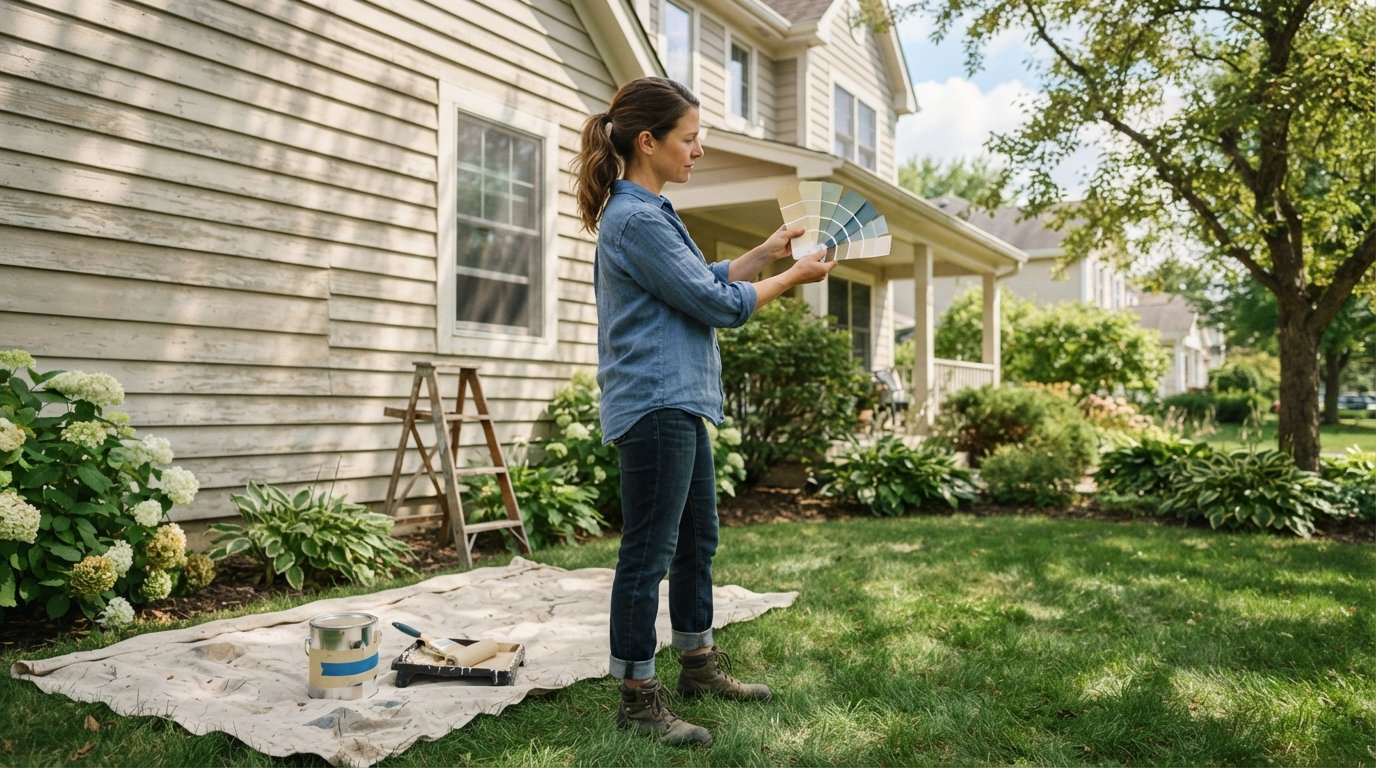
Paint chips are a starting point, not a final answer. The same color can look dramatically different depending on the direction your walls face, the time of day, and the surrounding landscape. A north-facing wall receives cool, indirect light and will make colors appear darker and bluer. A south-facing wall gets warm, direct sun and can wash out lighter colors or make them look yellow. East-facing walls are brightest in the morning, west-facing walls in the afternoon. Trees, neighboring buildings, and even your driveway can reflect color onto your home.
The only reliable way to choose an exterior color is to test it on the actual surface. Buy sample pots or quart sizes of your top two or three candidates and paint large swatches (at least two feet by two feet) in several locations: one on a sunny wall, one on a shaded wall, and one near the trim and roof line. Let the paint cure for at least 48 hours, then observe the swatches at different times of day, morning, midday, and late afternoon. Look at them under artificial light at night as well, since porch lights and landscape lighting can shift color perception.
While you are testing, pay attention to how the color interacts with your fixed elements. Does the swatch make your roof look muddy? Does it clash with the stone veneer? Does it make your trim look dingy? If a color looks good in isolation but fights with the roof, it will never feel right. Also check the color against your neighbors' homes. You do not need to match them, but you should avoid a jarring clash that could affect resale value. Once you have a winner, record the brand, product line, base, and color code. Paint formulas can change slightly over time, and having the exact code makes touch-ups far easier.
Factor in Longevity, Maintenance, and Curb Appeal ROI
A beautiful exterior paint job is an investment, and like any investment, it should be evaluated on both upfront cost and long-term return. Quality exterior paint costs more per gallon than budget options, but it typically lasts seven to ten years or more, compared to three to five years for lower-grade products. When you factor in the labor cost of repainting, which is often 70 to 80 percent of the total project, using a premium paint is almost always the more economical choice over time. Look for paints with strong UV resistance, mildew resistance, and a warranty of at least 15 years on the product itself. Keep in mind that warranties often cover only the paint, not the labor, so read the fine print.
Curb appeal is not just about aesthetics; it has measurable financial impact. According to real estate industry surveys, a well-executed exterior paint job can return a significant portion of its cost at resale, sometimes 50 to 100 percent depending on the market and the condition of the home. Neutral, broadly appealing colors tend to perform best for resale because they attract a wider pool of buyers. Bold or highly personalized colors may appeal to you, but they can narrow your buyer pool if you sell within a few years. If you plan to stay in your home for a decade or more, feel free to express your personal style; if you might sell soon, lean toward timeless palettes.
Maintenance also affects longevity. Even the best paint needs occasional care. Inspect your exterior annually for signs of cracking, peeling, or mildew. Clean siding with a mild detergent and soft brush, and touch up small areas before they become big problems. Keep gutters clear so water does not run down walls and stain or blister the paint. Trim shrubs and trees away from the siding to improve airflow and reduce moisture. These simple habits can add years to the life of your paint job and keep your curb appeal sharp.
When you are ready to move from color selection to execution, getting multiple quotes from qualified local painters is the smartest next step. A platform like FreeQuotes.Contractors connects homeowners with pre-vetted professionals who can assess your specific surfaces, recommend the right products, and provide competitive pricing. Comparing at least three quotes helps you understand the going rate in your area and spot outliers, whether suspiciously low or unnecessarily high. Ask each contractor about their prep process, the paint system they use, and their warranty on labor. A thorough, transparent bid is a strong signal that the contractor takes pride in lasting results.
Choosing exterior paint colors that last and boost curb appeal is a process, not a single decision. It starts with understanding your home's fixed elements and climate, narrows through disciplined palette selection and real-world testing, and finishes with quality products applied by skilled hands. Take your time, test thoroughly, and invest in durability. The result is a home that looks welcoming and well-cared-for today and continues to turn heads for years to come.