
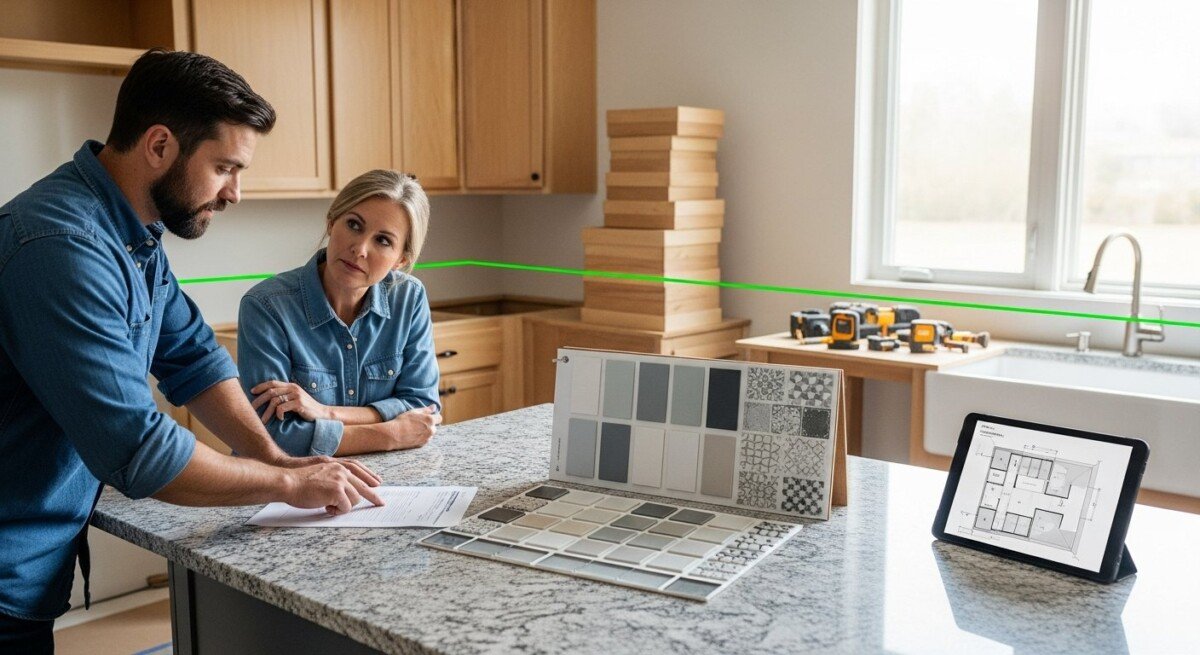
How Contractors Estimate Renovation Costs for Homeowners
Learn how professional contractors estimate renovation costs, why detailed quotes matter, and how to avoid budget overruns on your home project.
By Alexia Mabel
Learn more about Home Remodeling for guides, costs, and what to expect.
Compare Home Remodeling Pros Near You

Enter your ZIP code to compare top-rated local professionals and request free quotes.
You’ve finally decided to tackle that kitchen remodel or finish the basement. You have a budget in mind, but when you start talking to contractors, the estimates you receive seem to vary wildly. One quote is surprisingly low, another is shockingly high, and a third is somewhere in the middle but with a vague list of what’s included. This confusing scenario is how many homeowners discover the complex process of renovation cost estimation. If you ignore the details and choose based on price alone, you risk serious budget overruns, unfinished work, or subpar materials. Understanding how a professional contractor builds an estimate is your first, most crucial step toward a successful and stress-free home improvement project.
Understanding How Contractors Estimate Renovation Costs
At its core, a contractor’s estimate is a detailed forecast of the total project cost. It’s not a random guess, but a calculated breakdown of labor, materials, overhead, and profit. A trustworthy estimate translates your vision into a tangible, line-by-item financial plan.
This process happens because every home and project is unique. Two identical-looking bathroom remodels can have vastly different costs based on what’s behind the walls, the quality of fixtures chosen, and the local permitting requirements. Contractors must account for both the visible work and the potential hidden challenges they might uncover.
While all homes are affected, older homes often see more variance in estimates due to unknown conditions like outdated wiring, plumbing, or structural surprises. Newer homes might have more predictable costs, but material choices and design complexity still play a huge role.
Why This Matters for Your Home
Getting a clear, detailed estimate protects your investment. It ensures you and your contractor are on the same page about the project’s scope, preventing misunderstandings that can lead to conflict and extra charges later. A proper estimate acts as a roadmap for your renovation journey.
Without this clarity, you risk significant financial strain. A lowball estimate might mean the contractor cuts corners, uses inferior materials, or hits you with constant change orders. Conversely, an inflated estimate wastes your money. A detailed breakdown gives you the power to compare quotes fairly and make informed decisions about where to spend.
Ultimately, a professional estimate safeguards your home’s value. It ensures the work is done correctly, with proper materials and permits, which protects your safety and boosts your property’s long-term worth. Shoddy work from a poorly planned budget can actually decrease your home’s value and create safety hazards.
If you notice signs of this issue in your home, it may help to speak with a qualified contractor. Request a free quote or call to explore your repair or remodeling options.
Common Problems Homeowners Experience
The most frequent issue homeowners face is the “apples-to-oranges” problem. You receive three estimates with three different totals, but they all describe your project differently. One might include demo and disposal, while another lists it as an extra. One might specify mid-grade cabinets, another uses builder-grade.
This lack of standardization makes comparison nearly impossible and sets the stage for budget nightmares. You might think you’re choosing the best value, but you’re often comparing completely different scopes of work and material quality. This often leads to the dreaded “change order,” where unforeseen costs are added mid-project.
- Vastly different quote amounts for the same described project.
- “Lump sum” estimates with no itemized breakdown of costs.
- Exclusions for critical items like waste removal, permits, or finishing touches.
- Unrealistically low estimates that seem too good to be true (they usually are).
- Vague descriptions like “install flooring” without specifying material, brand, or square footage.
- No allowance for potential hidden issues common in renovations.
How Professionals Solve the Problem
A reputable contractor follows a systematic process to create a reliable estimate. They start by thoroughly understanding your goals and then translate that vision into measurable, purchasable, and installable components. This methodical approach minimizes surprises for both of you.
Professional work is safer and more reliable because it’s based on experience and real-world data. They know how long tasks truly take, what materials withstand wear and tear, and what local building codes require. This expertise prevents costly mistakes and ensures the renovation is built to last, unlike many DIY fixes that can lead to bigger problems down the road. For a deeper dive into managing the financial conversation, our guide on how to negotiate home renovation costs successfully offers practical strategies.
- Consultation & Scope Definition: They discuss your needs, take measurements, and define the exact project scope.
- Material Takeoff: They create a detailed list of every material needed,from lumber and drywall to fixtures and fasteners.
- Labor Calculation: They estimate the hours required for each trade (carpentry, plumbing, electrical, etc.) based on the scope.
- Pricing: They apply current costs to the material list and labor hours, often adding a contingency (typically 10-20%) for unknowns.
- Overhead & Profit: They factor in business costs (insurance, tools, vehicles) and a fair profit margin to stay in business.
- Proposal Assembly: They compile everything into a clear, written proposal you can review and sign.
A professional inspection can reveal hidden issues before they become expensive repairs. Compare contractor quotes here or call to discuss your project.
Warning Signs You Should Not Ignore
When reviewing an estimate, certain red flags should prompt you to ask more questions or seek another opinion. These signs often indicate a contractor who may be inexperienced, cutting corners, or planning to use pressure tactics later.
Ignoring these warning signs can lead to a project that spirals out of control financially. Early action,by insisting on clarity and detail,protects you from agreeing to a contract that is vague or unfair. It’s far easier to walk away from a bad estimate than to fire a bad contractor halfway through a job.
- The contractor pressures you to sign immediately, often with a “today-only” discount.
- They ask for a large cash deposit or full payment upfront before any work begins.
- The estimate is handwritten on a generic form or even a napkin, lacking company letterhead.
- They are hesitant or refuse to provide references from past clients.
- They suggest pulling permits yourself or skipping them altogether to “save money.”
- Their verbal promises don’t match what’s written in the proposal.
What Affects the Cost of Repairs or Installation
Many factors influence your final renovation price. Understanding these helps you see why your neighbor’s bathroom cost less and allows for more productive conversations with contractors. The key is knowing which levers you can pull to align the project with your budget.
Material choices have one of the biggest impacts. Opting for custom cabinetry, natural stone countertops, or imported tiles will dramatically increase costs compared to stock cabinets, quartz, or ceramic tile. Similarly, the age and condition of your home play a huge role; opening up a wall in a 1920s craftsman often reveals more necessary work than in a 1990s home.
Labor requirements and accessibility are also major cost drivers. Is the worksite easy to access, or will workers need to carry materials up three flights of stairs? Is the project a simple room refresh, or does it involve moving plumbing walls and electrical panels? Each added complexity increases time and skilled labor costs.
Costs can vary depending on the condition of your home. The best way to know the price is to get a personalized estimate. Request free quotes from contractors or call today.
How to Choose the Right Contractor
Your choice of contractor is more important than any design decision. The right professional will guide you through the estimation and building process smoothly, while the wrong one can turn your dream into a nightmare. Your due diligence before signing a contract is your best defense.
Start by verifying their credentials and reputation. Then, use the estimate as a key tool for evaluation. A contractor who takes the time to provide a thorough, transparent estimate is often one who will take equal care with the construction itself. They respect your need to understand the investment you’re making.
- Check for a valid state license and proof of liability insurance and workers’ compensation.
- Read online reviews and ask for 2-3 recent references you can call and visit.
- Insist on a detailed, written estimate that breaks down costs by category (demo, materials, labor, etc.).
- Always compare at least three detailed quotes from pre-screened contractors.
- Confirm their experience with projects of similar size, style, and budget to yours.
Long-Term Benefits of Professional Work
Investing in a professionally estimated and executed renovation pays dividends long after the project is complete. The initial clarity and precision lead to a final product that performs better, lasts longer, and protects your family. It’s an investment in your daily quality of life and your financial future.
Beyond immediate satisfaction, professional work enhances safety through proper structural and electrical work. It improves durability by using correct installation techniques and materials suited for their purpose. This often leads to better energy efficiency (through proper insulation and window installation) and significantly increases your home’s resale value. A well-documented, permitted renovation is a strong selling point.
Ultimately, you reduce future maintenance costs and headaches. A tile shower installed correctly won’t leak. A kitchen with proper ventilation won’t have moisture damage. The peace of mind that comes from knowing the job was done right is perhaps the greatest long-term benefit of all. Understanding the estimate process is the first step to securing these benefits, and learning how to negotiate home renovation costs successfully ensures you get fair value for your investment.
How long should a contractor’s estimate be valid?
A typical estimate is valid for 30 to 90 days. This protects both you and the contractor from sudden price fluctuations in materials like lumber or metal. If your project is delayed, ask for an updated estimate to ensure pricing remains accurate before you sign a contract.
What’s the difference between an estimate and a quote?
An estimate is an educated projection of costs and can change. A quote (or bid) is typically a fixed-price offer for the defined scope of work. In practice, the terms are often used interchangeably, but you always want a fixed-price proposal for your project before work begins.
Should I always choose the lowest estimate?
Not necessarily. The lowest estimate can be a red flag for cut corners, inferior materials, or an incomplete scope. Compare the line items and inclusions carefully. Often, the middle-priced estimate from a highly-recommended contractor offers the best balance of value and quality.
What should a good estimate include?
A good estimate includes a detailed scope of work, an itemized list of materials (with quality/grade specified), labor costs, a project timeline, payment schedule, and information on warranties, licenses, and insurance. It should also note who is responsible for obtaining permits.
Can I get an estimate over the phone or online?
You can get a very rough ballpark figure, but a reliable estimate requires an in-person site visit. A contractor needs to see the space, assess existing conditions, take measurements, and discuss your specific needs to provide an accurate price.
What is a contingency fund, and do I need one?
A contingency fund (usually 10-20% of the total budget) is money set aside for unforeseen issues, like rotten subfloor discovered during a bathroom remodel. Including it in your overall budget planning is wise, even if your contractor’s estimate already includes a small contingency on their end.
How do change orders work?
A change order is a written amendment to the contract if you request additional work or changes mid-project. It should describe the change, the adjusted cost, and any impact on the timeline. Reputable contractors will not proceed with extra work without a signed change order.
Understanding how contractors estimate renovation costs empowers you to be an informed partner in your home improvement project. It moves you from feeling confused by numbers to being confident in your decisions. By recognizing the value of a detailed estimate, you protect your budget, your home, and your peace of mind. If you’re planning a renovation, your first smart step is to gather clear, comparable quotes from qualified professionals. This simple act lays the foundation for a successful transformation of your home.
Learn more about Home Remodeling for guides, costs, and what to expect.
Compare Home Remodeling Pros Near You
Enter your ZIP code to compare top-rated local professionals and request free quotes.