
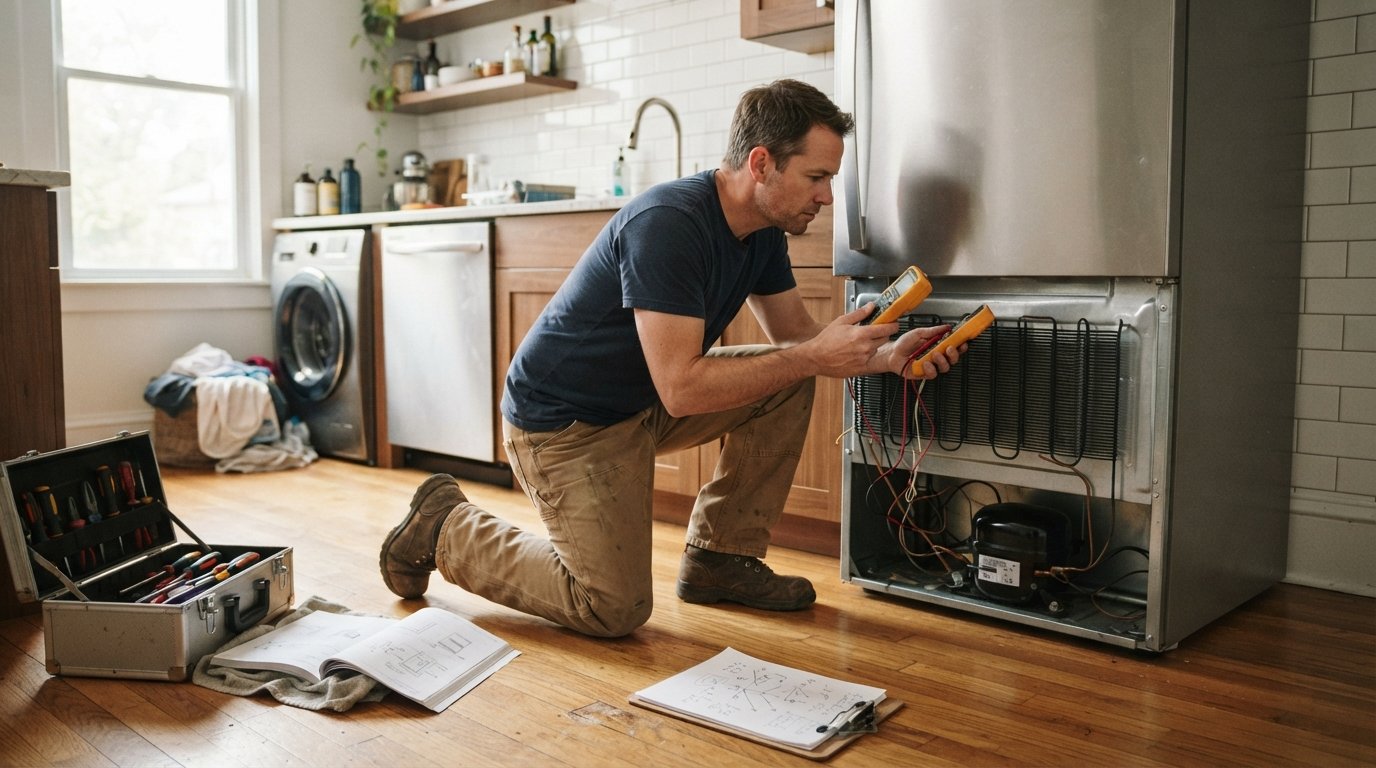
Appliance Maintenance and Repair Versus Replacement Guide
Use this appliance maintenance and repair versus replacement guide to decide with confidence. Call (833)-439-3727 for help finding local pros.

By Patrick Parker
Learn more about Appliance Repair or Maintenance for guides, costs, and what to expect.
Compare Appliance Repair or Maintenance Pros Near You

Enter your ZIP code to compare top-rated local professionals and request free quotes.
A failed refrigerator, a leaking washing machine, or an oven that will not heat can disrupt your entire household in hours. When that moment arrives, the hardest question is rarely about the part itself: it is whether to invest in a repair or put that money toward a new machine. This appliance maintenance and repair versus replacement guide walks you through the decision the way a contractor or a seasoned homeowner would, using age, repair cost, energy use, and safety as your measuring sticks.
Start With the Lifespan Rule, Then Look at the Numbers
Every major appliance has an expected service life. Once a unit passes that range, repairs become a temporary patch rather than a long-term fix. The general averages most technicians use are:
- Refrigerators: 13 to 17 years
- Clothes washers and dryers: 10 to 13 years
- Dishwashers: 9 to 12 years
- Ranges and ovens: 13 to 15 years
- Microwaves: 9 to 10 years
- Water heaters: 8 to 12 years
These numbers matter because they anchor the math. If your dishwasher is three years old and the control board fails, a repair almost always wins. If the same dishwasher is eleven years old, the same repair may buy you a year at best. Age alone does not decide the outcome, but it sets the odds, and it should be the first thing you confirm before you call anyone. Write the model number down, look up the manufacture date, and calculate the age in years, not in vague memories of when you bought the house.
Once you know the age, compare it to the average lifespan. A unit in the first half of its expected life is a repair candidate almost every time. A unit in the second half is a replacement candidate unless the repair is cheap and the diagnosis is simple. A unit past its expected lifespan is usually a replacement, even if a technician offers to fix it, because you will likely face a second failure within months.
The 50 Percent Rule and How to Apply It
The most widely used benchmark in appliance maintenance and repair versus replacement decisions is the 50 percent rule. If the quoted repair costs more than half the price of a comparable new appliance, replacement is usually the smarter financial move. If it costs less than half, repair tends to win.
Apply it with real numbers rather than gut feelings. Suppose a repair quote comes in at 420 dollars and a comparable new refrigerator costs 1,100 dollars. The repair is about 38 percent of replacement, so it sits below the threshold and is worth considering, especially if the unit is under eight years old. Now suppose the same quote is 680 dollars on a seven-year-old unit. That is roughly 62 percent of replacement cost, and the money is better spent on a new machine with a warranty.
There is one important exception: high-end and built-in appliances. A built-in refrigerator or a professional range can cost several thousand dollars, so a repair that looks expensive in absolute terms may still be a small fraction of replacement. Run the percentage, not the dollar amount, before you decide.
Energy Costs: The Hidden Replacement Argument
Older appliances consume far more electricity and gas than modern equivalents. A refrigerator built in the 1990s can use twice the electricity of a current Energy Star model. A top-loading washer from the same era may use 25 to 30 gallons of water per load, while a modern high-efficiency model uses 12 to 15.
This changes the math in a way most homeowners overlook. A repair that keeps a 15-year-old refrigerator running for three more years also keeps that higher utility bill running for three more years. In some cases the annual energy savings from a new unit offset a meaningful share of the purchase price within the first few years, which effectively lowers the true cost of replacement.
You can estimate this yourself. Find the yellow EnergyGuide label on your current appliance or look up its model online, then compare the estimated annual operating cost to that of a new Energy Star model. Multiply the difference by the number of years you expect to keep the appliance. If the total savings approach or exceed the repair quote, replacement becomes the stronger financial choice even when the repair itself looks affordable.
Repair Frequency: One Breakdown or a Pattern?
A single failure on an otherwise healthy appliance is normal. A pattern of failures is a warning sign. If you have called a technician three times in eighteen months for the same unit, you are no longer maintaining an appliance; you are funding a slow decline. Each repair resets the clock only briefly, and the next failure usually arrives sooner than the last.
Keep a simple service log for every major appliance: the date, the symptom, the part replaced, and the cost. This record does two things. First, it shows you the cumulative spending, which is often far higher than homeowners remember. Second, it gives any future technician a clear history that speeds up diagnosis. When cumulative repair spending over two years approaches 50 percent of replacement cost, the pattern itself is the answer.
There is also a practical inconvenience factor. A refrigerator that fails repeatedly forces you to throw out food. A washer that breaks mid-cycle damages clothes and floors. When reliability matters as much as money, replacement is a legitimate decision even when the pure math is close.
Safety Issues That End the Debate
Some problems should never be repaired. Gas leaks, persistent electrical shorts, burning smells, scorched wiring, and cracked heat exchangers in gas appliances are replacement triggers, not repair projects. These conditions pose fire, carbon monoxide, or shock hazards, and no cost savings justify living with them.
Refrigerant leaks in older refrigerators and freezers deserve similar caution. The refrigerant itself may be expensive or discontinued, and the repair may not hold. Water heaters with tank corrosion, rust streaks, or moisture around the base are also near the end of their lives; a leaking tank can cause significant water damage long before it fails completely.
If a technician tells you a unit is unsafe to operate, treat that as final. Get a second opinion only if you doubt the diagnosis, never because you hope to hear a different answer.
Warranties, Parts Availability, and the Repair Reality
Before you approve any repair, ask two questions: is the appliance still under warranty, and are the parts still available? A unit within its manufacturer warranty should almost always be repaired through an authorized service provider, because the covered repair costs you little or nothing. Skipping that step can void coverage.
Parts availability is the quieter issue. Manufacturers typically stock parts for seven to ten years after a model is discontinued. Once that window closes, repairs depend on aftermarket suppliers, and the wait can stretch for weeks. A refrigerator that cannot be fixed for three weeks is, for practical purposes, a refrigerator you no longer own.
Labor rates add another layer. Most technicians charge a diagnostic fee plus parts and labor, and the diagnostic fee is often credited toward the repair if you proceed. Always ask for the total out-the-door price in writing before work begins, including the diagnostic charge, so you can compare it honestly against replacement.
Repair or Replace: A Quick Decision Framework
When you are standing in your kitchen with a broken appliance and a quote in hand, a short checklist keeps the decision rational. Work through these steps in order:
- Confirm the age of the appliance using the model and serial number.
- Get the full repair quote, including parts, labor, and diagnostic fees.
- Compare the quote to 50 percent of the cost of a comparable new unit.
- Check for safety issues, warranty coverage, and parts availability.
- Factor in energy savings and repair history over the past two years.
If the unit is young, the repair is under half the replacement cost, and the diagnosis is straightforward, repair. If the unit is old, the repair is expensive, the parts are scarce, or safety is involved, replace. Most real situations land somewhere between those poles, and the framework is what keeps you from overpaying on either side.
When a repair no longer makes sense, the next step is finding a qualified professional to handle installation or the larger repair work. Directories such as PlanRemodel's contractor directory let homeowners compare local, pre-vetted pros before committing, which is especially useful when you need an appliance installed correctly the first time. The same principle applies to related household systems: in our garage door maintenance and repair guide, we explain how routine upkeep prevents the kind of sudden failure that forces a rushed replacement decision.
Maintenance Habits That Delay the Decision
The best way to avoid an emergency repair-or-replace call is to maintain appliances before they fail. A few habits extend service life significantly and cost almost nothing.
- Clean refrigerator condenser coils every six to twelve months.
- Replace washer hoses every five years and check them for bulges.
- Run a dishwasher cleaning cycle monthly to prevent mineral buildup.
- Vacuum dryer lint traps and vents regularly to reduce fire risk.
- Flush the water heater annually to limit sediment accumulation.
These tasks take an afternoon per year and routinely add years to an appliance's life. They also give you early warning of problems, which turns a sudden emergency into a planned decision. A homeowner who knows the water heater is ten years old and has been flushed every year can budget for replacement on their own schedule instead of reacting to a leak.
Budgeting matters here as much as maintenance. Setting aside a small monthly amount for appliance reserves means that when replacement is the right call, the money is already there. Homeowners who plan ahead typically spend less overall because they can wait for sales, compare models calmly, and avoid financing a rushed purchase at a premium.
Making the Call With Confidence
The decision between appliance maintenance and repair versus replacement guide comes down to a handful of variables: age, repair cost as a percentage of replacement, energy use, repair history, safety, and parts availability. None of these factors is complicated on its own, but together they produce a clear answer in almost every case.
Repair when the appliance is young, the fix is affordable, and the unit has been reliable. Replace when age, cost, safety, or repeated failures point the other way. Either way, write down your numbers before you decide, because a decision made with a calculator is almost always better than one made in frustration. With a little maintenance and a simple framework, you can keep your appliances running longer and replace them only when it truly makes financial sense.