
Wood Fence Repair vs Replacement Cost: A Full Guide for 2026
Repair or replace your wood fence? Compare real costs, key factors, and a simple rule to make the best financial choice for your home.
By Adnan Nazir
Learn more about Fence and Gate Repairs for guides, costs, and what to expect.
Compare Fence and Gate Repairs Pros Near You

Enter your ZIP code to compare top-rated local professionals and request free quotes.
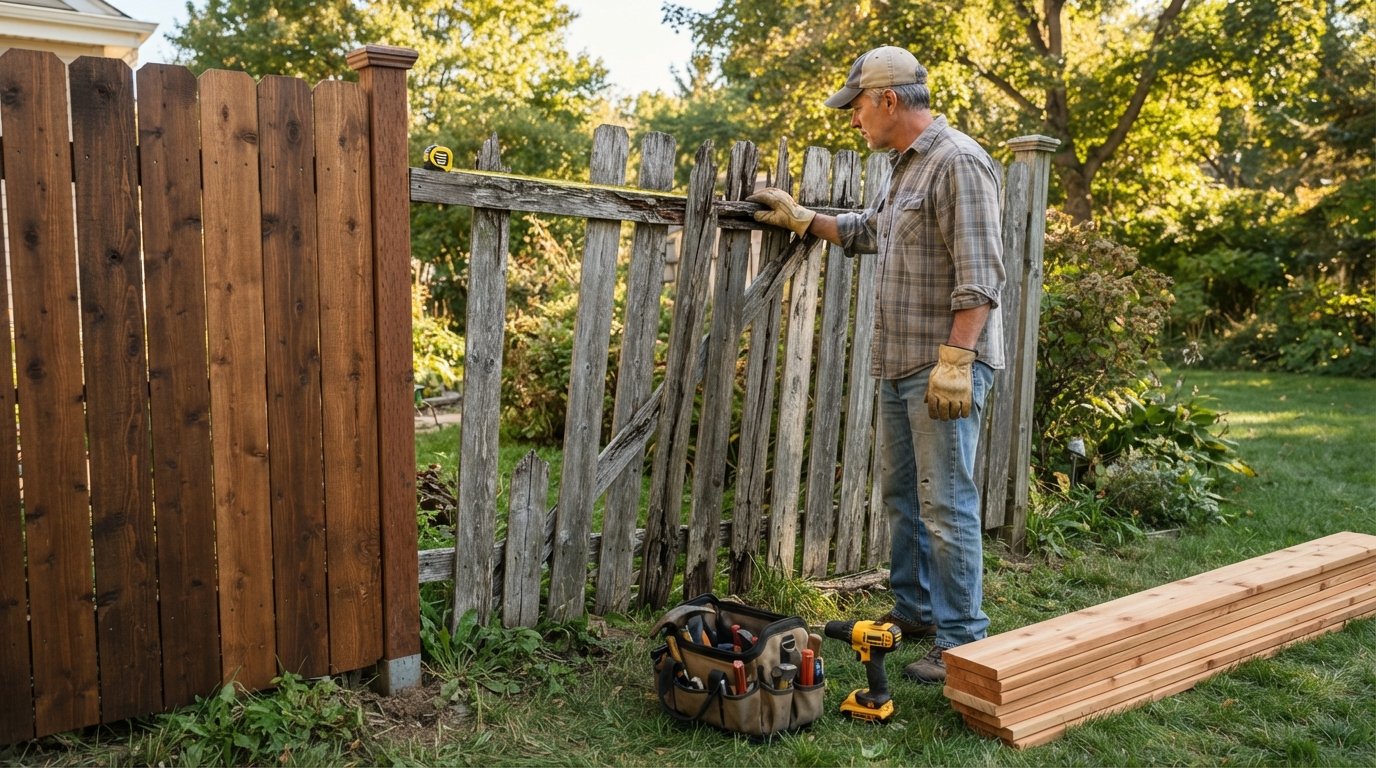
Your wood fence is showing its age, and you are facing a familiar homeowner dilemma. You can see the sagging gate, the cracked pickets, and the section that leans after the last storm. The question is no longer if you need to act, but whether you should patch it up or tear it all down. The decision between wood fence repair vs replacement cost is rarely just about the price tag on a quote, because it involves long-term value, the condition of your existing structure, and your property's overall appearance.
This guide breaks down the real numbers behind wood fence repair vs replacement cost, the specific signs that point to each option, and the hidden factors that influence your final estimate. By the end, you will have a clear framework to make a confident choice that fits your budget and your timeline.
Why the Repair vs Replace Decision Is Tricky
Many homeowners assume that repairing a fence is always the cheaper option. In the short term, that is often true. A small repair might cost a few hundred dollars, while a full replacement for a typical yard can run into the thousands. However, the math changes when you consider the lifespan of the remaining structure. If your fence is already 15 years old and showing widespread rot, spending money on a patch job might be like putting new tires on a car with a blown engine.
To make a smart choice, you need to assess three things: the age of the fence, the percentage of damaged material, and the cause of the damage. These factors drive the wood fence repair vs replacement cost comparison more than any single price list.
The Real Cost of Repairing a Wood Fence
Repair costs vary widely based on your location, the type of wood, and the extent of the damage. However, you can expect to pay for labor and materials on a per-project basis rather than a flat rate. On average, minor repairs that involve replacing a few pickets or fixing a loose hinge can cost between $150 and $400. Moderate repairs, such as replacing a section of rotted rails or resetting a leaning post, typically range from $300 to $800. Major repairs that involve structural work on multiple posts can easily climb to $1,500 or more.
One of the hidden costs in repair work is the labor involved in matching existing materials. If your fence was built with a specific type of cedar or pine that is no longer available, the contractor may need to special-order lumber. This adds time and money to the project. Additionally, repairs often require staining or painting the new wood to match the old, which is rarely included in the base quote.
Common Repair Scenarios and Their Costs
To give you a clearer picture, here are typical repair jobs and what you might expect to pay per linear foot or per component. These figures are national averages and can vary by region.
- Replacing pickets: Expect to pay $5 to $15 per picket for materials and labor, depending on wood grade and fence height.
- Replacing a single rail: A 8-foot rail can cost $20 to $50 for the wood, plus $50 to $100 for labor.
- Replacing a corner post: This is labor-intensive, often costing $150 to $300 per post because it requires concrete work and careful alignment.
- Re-setting a leaning section: If a post is still solid but shifted, the repair might cost $100 to $200 to brace and re-concrete.
The challenge with these individual repairs is that fixing one problem often exposes another. A contractor might start replacing a rotted picket only to find that the rail behind it is also decayed. This is why it is critical to get a detailed estimate that outlines the condition of the entire fence, not just the visible damage.
What a Full Wood Fence Replacement Costs
Replacement is a larger financial commitment, but it gives you a fresh start with a new warranty. The cost of a full wood fence replacement typically ranges from $20 to $40 per linear foot for standard pine or spruce. If you prefer cedar or redwood, which offer natural rot resistance, the price jumps to $30 to $50 per linear foot. For a typical quarter-acre lot with roughly 150 linear feet of fencing, this translates to a total project cost between $3,000 and $7,500.
This price usually includes the removal and disposal of the old fence, which is a significant convenience. However, you should ask whether the quote includes demolition. Some contractors charge an extra $500 to $1,000 to haul away the old materials. The replacement cost also assumes that the new posts will be set in concrete, which is the industry standard for stability.
When comparing wood fence repair vs replacement cost, remember that a new fence adds curb appeal and can increase your property value. A repaired fence, even if it looks decent, still carries the age and wear of the surrounding structure.
Key Cost Factors That Affect Both Options
Several variables influence the final price you will see on any estimate, whether you are repairing or replacing. Understanding these will help you evaluate quotes from different contractors and avoid surprise charges later.
Fence height and length. Taller fences require more material and more labor. A 6-foot privacy fence costs more per linear foot than a 4-foot decorative fence. Likewise, longer runs give contractors economies of scale, which can slightly reduce the per-foot cost on larger projects.
Wood species. Pressure-treated pine is the most economical choice, but it is prone to warping and checking over time. Cedar and redwood are more expensive upfront but offer better durability against moisture and insects. Your choice here directly impacts the quote and the lifespan of the fence.
Site conditions. If your fence is on a slope, the installation is more complex. Contractors may need to step the fence or use special post anchors to accommodate the grade. Rocky soil also makes digging post holes harder, which increases labor time.
Accessibility. If the contractor cannot get a truck close to the work area, they will have to carry materials by hand. This adds time and may incur an extra charge.
Permits and HOA rules. Some cities require a permit for fence replacement, but not for minor repairs. Your HOA might also have specific codes about fence height and materials. Check these before you start, because failing to comply can lead to fines or forced removal.
Repair vs Replace: A Decision Framework
To decide which path is right for you, apply the 50 percent rule. If the cost of repairing the fence is more than 50 percent of the cost of a full replacement, you are usually better off replacing it. This is because the repair will not address the underlying age and wear of the remaining structure, and you will likely face more repair bills within a few years.
Beyond the percentage rule, ask yourself these questions to guide your decision. First, how old is the fence? Most wood fences last 10 to 15 years with proper maintenance. If yours is approaching or past that age, replacement is a wiser investment. Second, what is the extent of the damage? If less than a third of the fence is damaged and the posts are still solid, repair is viable. Third, is there a systemic issue like termite damage or widespread rot? These problems compromise the integrity of the entire fence, making targeted repairs ineffective.
Signs That Point to Repair
A repair is the right choice when the structural core of your fence is still sound. This means the posts are firmly set in the ground without significant wobble, and the rails are mostly straight and solid. If the damage is localized to visible areas like a few cracked pickets, a broken gate latch, or a single section that leans after a storm, a repair will restore function and appearance at a fraction of the replacement cost.
Another sign that repair is appropriate is if the damage is purely cosmetic. Stains, mildew, and minor weathering do not affect the structural integrity of the wood. In these cases, a thorough cleaning and a fresh coat of stain or paint can make your fence look new for less than $300 in materials.
Signs That Point to Replacement
Replacement becomes the clear winner when the damage is widespread or structural. If you can push against several posts and they move freely in the soil, the anchors are failing. If you see large areas of soft, spongy wood that crumbles when touched, rot has likely spread through the core of the boards. Termite damage is another red flag, as it hollows out the wood from the inside and is difficult to fully eradicate with a patch repair.
Also, consider the overall aesthetic. If you have replaced pickets multiple times, the fence may look like a patchwork of different wood tones and styles. A new fence provides a uniform, clean look that enhances your home's exterior. In our guide on roof repair and replacement services in Arizona, we explain how similar logic applies to other major home systems, where age and damage concentration dictate the best course of action.
How to Get Accurate Quotes
Once you have a sense of which direction you are leaning, it is time to gather professional estimates. Never rely on a single quote for a project of this size. You should aim to get at least three detailed bids from licensed and insured contractors. This gives you a baseline for comparison and helps you identify any outliers that are either too high or suspiciously low.
When you request a quote, be specific about the scope of work. Describe the damage you have observed and ask the contractor to inspect the entire fence line. If you are considering a repair, ask the contractor to provide a quote for the repair as well as a separate quote for a full replacement. This gives you a direct comparison of the costs and makes the decision easier.
Ask each contractor about their warranty. A reputable company will stand behind their workmanship for at least one year. For a full replacement, look for a warranty that covers both materials and labor. For a repair, the warranty is typically limited to the specific components that were fixed.
For homeowners who want to streamline the process, using an online marketplace like FreeQuotes.Contractors can save time. You submit your project details once, and you receive multiple quotes from pre-vetted local contractors. This allows you to compare prices and approaches side by side without making dozens of phone calls.
The Hidden Cost of Doing Nothing
While you are weighing the costs of repair and replacement, it is worth considering the cost of inaction. A damaged fence can lower your property's curb appeal, which matters if you plan to sell your home soon. More importantly, a fence that is leaning or has loose boards is a safety hazard. It can fall on a child, a pet, or a neighbor's property, which creates a liability issue that is far more expensive than any fence repair.
A failing fence also fails to provide the privacy and security you expect from it. If you have a pool, a broken gate is a code violation and a serious safety risk. If you have a dog that can squeeze through a gap, the fence is not serving its primary purpose.
In many cases, waiting only makes the problem worse. Rot spreads, and a small section of damage can turn into a large one after a season of rain. By addressing the issue now, you can avoid a more costly emergency repair later.
Financing Your Fence Project
The cost of a new fence can be a burden on your budget, but there are ways to manage it. First, check if your homeowner's insurance covers any of the damage. Most policies do not cover general wear and tear, but they may cover damage from a sudden event like a fallen tree or a vehicle collision. If the damage is from a covered peril, your out-of-pocket cost could be much lower.
If insurance does not apply, consider financing options. Many contractors offer payment plans through third-party lenders. These plans often come with promotional periods of zero interest if you pay the balance within a certain timeframe. Alternatively, you could use a home equity line of credit, which typically offers lower interest rates than credit cards.
Finally, remember that a wood fence is an investment. It adds value to your property and improves your enjoyment of your outdoor space. When you compare the cost of a new fence against the years of service it will provide, the expense becomes easier to justify.
Whether you choose to repair or replace, the most important step is to work with a professional who can give you honest advice and quality workmanship. The decision between wood fence repair vs replacement cost is not just about the initial estimate. It is about the long-term health of your property, your peace of mind, and the safety of your family. Take your time, get multiple quotes, and make the choice that best fits your home and your budget.
Learn more about Fence and Gate Repairs for guides, costs, and what to expect.
Compare Fence and Gate Repairs Pros Near You
Enter your ZIP code to compare top-rated local professionals and request free quotes.