
Energy Efficient Home Improvements With Best ROI
Cut utility bills and boost resale value with energy efficient home improvements with best return on investment. Call (833)-439-3727 for trusted contractor quotes.
By Alexia Mabel
Learn more about Insulation Installation or Upgrade for guides, costs, and what to expect.
Compare Insulation Installation or Upgrade Pros Near You

Enter your ZIP code to compare top-rated local professionals and request free quotes.
Every homeowner wants lower utility bills and a higher home value, but not every green upgrade delivers. Some energy efficient home improvements with best return on investment pay for themselves in a few years, while others take decades to break even. The difference often comes down to climate, current energy prices, and how well the project is executed. This guide cuts through the marketing hype and focuses on the upgrades that consistently rank highest for cost recovery, according to industry data and real-world payback periods. You will learn which projects to prioritize, how to estimate savings for your specific home, and what to ask contractors before signing a quote.
The Financial Case for Energy Efficiency: Payback Periods and Resale Value
Before choosing a project, understand two numbers: payback period and return on investment (ROI). Payback period is the time it takes for energy savings to equal the upfront cost. ROI measures how much of the project cost you recoup at resale. A project can have a fast payback but low resale ROI, or vice versa. The best energy efficient home improvements with best return on investment balance both. For example, attic insulation often pays back in 2 to 4 years and recoups over 80 percent of its cost at sale. A geothermal heat pump might slash heating bills by 50 percent but costs tens of thousands upfront, stretching payback to 10 years or more in some regions.
Resale value matters because energy-efficient homes increasingly command a premium. Studies from the National Association of Realtors show that buyers will pay more for homes with energy-efficient features, especially in markets with high utility costs. However, the premium varies by region and by the visibility of the upgrade. A new HVAC system with a high SEER rating is a strong selling point, while added insulation is invisible but still valued through lower utility bills. To estimate ROI for your area, check local real estate listings and ask a realtor about energy-efficient home premiums. Also consider federal tax credits and utility rebates, which effectively reduce your net cost and improve both payback and ROI.
Top High-ROI Upgrades: Attic Insulation, Smart Thermostats, and Heat Pumps
Not all energy improvements are created equal. The following three categories consistently deliver the strongest financial returns for most homeowners, provided they are correctly sized and installed. Each has different upfront costs, savings potential, and contractor requirements.
Attic Insulation and Air Sealing
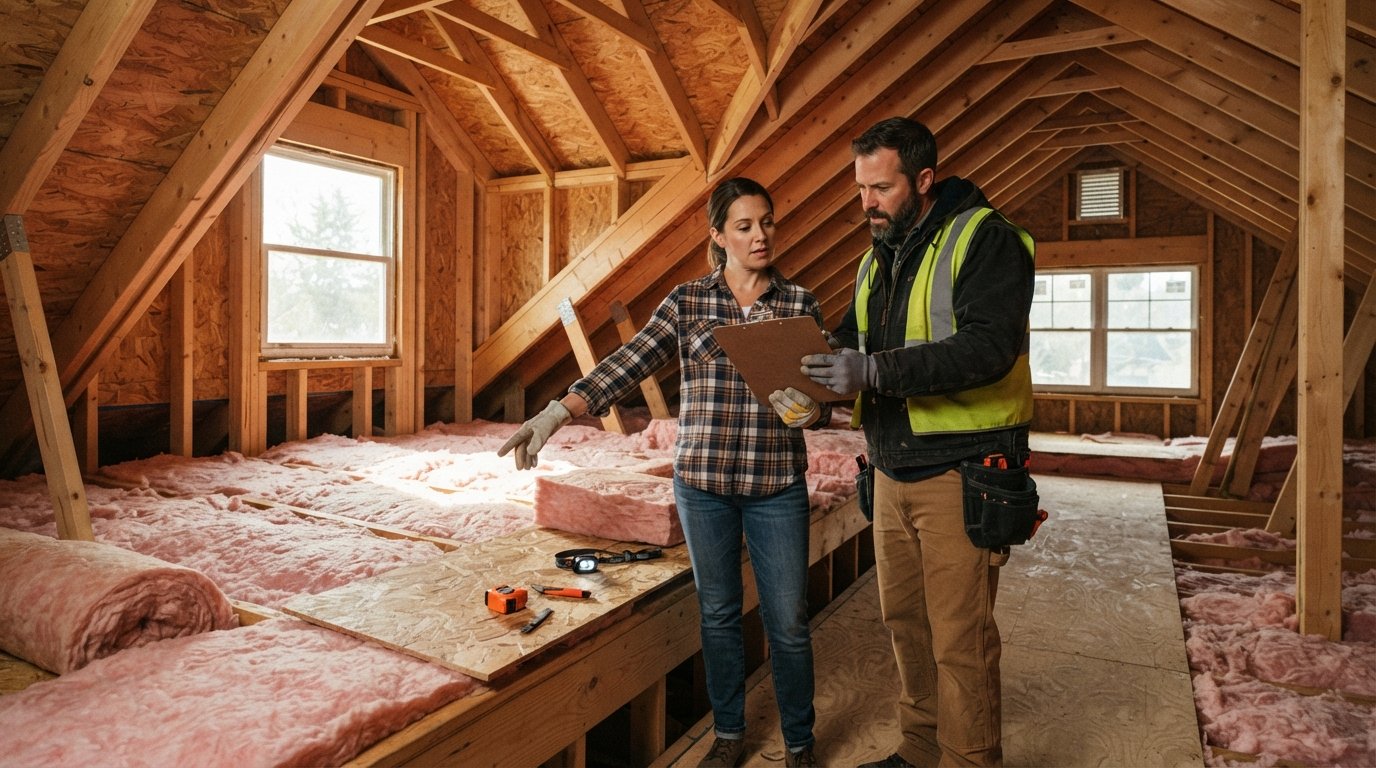
Attic insulation is often the single most cost-effective energy upgrade. Heat rises, and in winter, a poorly insulated attic lets warm air escape; in summer, it allows heat to penetrate the living space. Adding insulation to meet current Department of Energy recommendations can cut heating and cooling costs by 10 to 20 percent. Air sealing (plugging gaps around wires, pipes, and vents) amplifies those savings. The typical installed cost for blown-in insulation ranges from 1,500 to 3,500 dollars for an average attic, and many utility companies offer rebates that cover part of the cost. Payback is frequently under 4 years, and the ROI at resale is high because buyers appreciate lower utility bills. When hiring an insulation contractor, ask for a blower door test before and after to verify air sealing effectiveness.
Smart Thermostats
A smart thermostat is a low-cost, high-impact upgrade. These devices learn your schedule and adjust temperatures automatically, potentially saving 8 to 15 percent on heating and cooling annually, according to Energy Star. The device itself costs 150 to 300 dollars, and many utilities offer rebates that bring the net cost below 100 dollars. Installation is usually DIY-friendly, but if you are not comfortable with wiring, a handyman or HVAC technician can install it for around 100 dollars. Payback is typically one to two years. For the best energy efficient home improvements with best return on investment, a smart thermostat is a no-brainer because it requires minimal investment and starts saving immediately.
Heat Pump Systems (Air-Source and Geothermal)
Heat pumps are far more efficient than traditional furnaces or baseboard heaters. An air-source heat pump can deliver 2 to 3 units of heat for every unit of electricity, compared to 0.95 for a fossil fuel furnace. Upfront costs are higher: 4,000 to 8,000 dollars installed for a standard air-source system, and 15,000 to 30,000 dollars for geothermal. However, federal tax credits under the Inflation Reduction Act cover up to 30 percent of the cost (capped at 2,000 dollars for air-source heat pumps, and more for geothermal), and many states add rebates. In moderate climates, payback can be 5 to 8 years. In colder climates, a cold-climate heat pump may still be viable with proper sizing. The resale ROI is strong because buyers recognize the long-term savings and comfort benefits.
How to Estimate Savings for Your Specific Home
Generic savings percentages are a starting point, but your actual savings depend on your home's size, age, insulation levels, windows, and local energy prices. To get a realistic estimate, gather your last 12 months of utility bills and calculate your average monthly heating and cooling costs. Then use the Department of Energy's Home Energy Saver tool or ask a qualified energy auditor for a home energy assessment. An auditor will perform a blower door test and infrared scan to identify leaks and insulation gaps, then provide a prioritized list of improvements with estimated savings and costs.
For a more precise payback calculation, use this formula: Payback (years) = Net project cost / Annual energy savings. Net project cost equals the contractor quote minus any rebates or tax credits you qualify for. Annual energy savings can be estimated from the auditor's report or from Energy Star's savings calculators. For example, if attic insulation costs 2,500 dollars net after rebates and saves 400 dollars per year, payback is 6.25 years. If you plan to sell before payback, focus on upgrades with high resale ROI, such as insulation and HVAC, which buyers value even if the current owner has not recouped the full cost. To find pre-vetted contractors for energy audits and installations, you can explore contractors for energy-saving home improvements in your area.
Federal Tax Credits and Utility Rebates: What Qualifies
The Inflation Reduction Act (IRA) introduced generous incentives for energy-efficient home improvements. As of 2026, the following federal tax credits are available: 30 percent of the cost of qualifying heat pumps (up to 2,000 dollars annually), 30 percent of insulation and air sealing costs (up to 1,200 dollars), 30 percent of qualified windows (up to 600 dollars), and 30 percent of electrical panel upgrades (up to 600 dollars) when needed for electrification. Geothermal heat pumps qualify for 30 percent with no cap. These credits are non-refundable but can be carried forward. In addition, many states and utilities offer rebates that can be combined with federal credits. For example, a utility might offer 500 dollars for a smart thermostat, and the state might add another 200 dollars. Always check the Database of State Incentives for Renewables and Efficiency (DSIRE) for your zip code.
To claim the credits, keep receipts and manufacturer certification statements. You will need to file IRS Form 5695 with your tax return. For rebates, apply before or immediately after installation, as funds can run out. Some rebates require using a participating contractor. Always ask your contractor whether they are enrolled in utility rebate programs. A knowledgeable contractor can often handle the paperwork for you. Also note that the credits reset annually, so spreading projects across two tax years may maximize your benefit.
Questions to Ask HVAC and Insulation Contractors During the Quote Process
Hiring the right contractor is as important as choosing the right upgrade. A shoddy installation can erase expected savings and even create safety hazards. When you request quotes, ask these questions to separate qualified professionals from fly-by-night operators.
- Are you licensed and insured in my state, and can you provide proof? (Check with your state licensing board.)
- Will you perform a Manual J load calculation for HVAC sizing, and a blower door test for insulation? (Proper sizing is critical for efficiency.)
- What is your warranty on labor and materials, and who honors it if you sell your home?
- Are you enrolled in any utility or state rebate programs, and will you help with the paperwork?
- Can you provide references from at least three recent customers with similar homes?
Beyond these questions, ask for a written contract that specifies the scope of work, model numbers, insulation R-values, and cleanup responsibilities. Avoid contractors who pressure you for a large upfront deposit or who cannot explain the technical details in plain language. For HVAC, confirm that the contractor will perform a startup and commissioning report, including refrigerant charge and airflow measurements. For insulation, ensure they will not block soffit vents and will provide a certificate of insulation thickness. If you need help finding qualified local professionals, PlanRemodel offers a directory of pre-vetted contractors and educational resources to guide your selection.
Other Upgrades Worth Considering: Windows, Doors, and Solar
While attic insulation, smart thermostats, and heat pumps top the ROI list, a few other improvements can be worthwhile in specific situations. Window replacement, for example, has a lower ROI (typically 60 to 70 percent) and longer payback (15 to 20 years), but it improves comfort and reduces drafts. If your windows are single-pane and leaky, upgrading to Energy Star certified windows may be justified, especially with the 600 dollar tax credit. Similarly, exterior doors with insulated cores can improve efficiency and security. Solar panels have become more affordable, with payback periods of 7 to 10 years in sunny states, but they are not for every roof or budget. Before investing in solar, maximize efficiency first with insulation and air sealing, as it is cheaper to reduce demand than to generate more power.
Another often-overlooked upgrade is duct sealing. In homes with forced-air systems, leaky ducts can waste 20 to 30 percent of conditioned air. Sealing ducts in attics or crawlspaces can cost 1,000 to 2,500 dollars and deliver savings comparable to insulation. Ask your HVAC contractor to include a duct leakage test in their assessment. Finally, consider a heat pump water heater if your current water heater is over 10 years old. It can cut water heating costs by more than half, and it qualifies for a 30 percent tax credit (up to 2,000 dollars). The payback is typically 4 to 6 years.
Prioritizing Your Upgrades for Maximum Return
The best strategy is to start with the lowest-cost, highest-return projects first. A typical priority order is: 1) air sealing and attic insulation, 2) smart thermostat, 3) duct sealing (if applicable), 4) HVAC upgrade to a heat pump, 5) water heater upgrade, and 6) windows and doors. This sequence ensures that when you invest in a new HVAC system, the home is already sealed and insulated, so the system can be sized correctly and operate at peak efficiency. It also maximizes your access to annual tax credit caps, since you can spread projects over multiple years.
Before committing to any project, get at least three quotes from licensed contractors. Use the questions above to compare not just price but also scope, warranties, and rebate assistance. Remember that the lowest bid is not always the best value, especially for HVAC and insulation, where installation quality drives performance. By focusing on energy efficient home improvements with best return on investment, you can lower your bills, increase your home's comfort, and boost its resale value, all while reducing your carbon footprint. For help finding qualified contractors and comparing quotes, reach out to (833)-439-3727 or use our online directory to request free, no-obligation estimates today.
Learn more about Insulation Installation or Upgrade for guides, costs, and what to expect.
Compare Insulation Installation or Upgrade Pros Near You
Enter your ZIP code to compare top-rated local professionals and request free quotes.