
Emergency Electrical Repair: Call Before It Worsens
Don't wait for a flicker to become a fire. Learn why you must call for emergency electrical repair before it worsens and how to act fast.
By Alexia Mabel
Learn more about Electrical and Wiring Repair for guides, costs, and what to expect.
Compare Electrical and Wiring Repair Pros Near You

Enter your ZIP code to compare top-rated local professionals and request free quotes.
It starts as a faint buzzing from the breaker panel or a flicker in the hallway light. You tell yourself it is nothing, a momentary glitch that will sort itself out. But by the time the smell of burnt plastic drifts through the house, what was a simple loose connection has become a serious fire hazard. The truth about electrical problems is that they are progressive. A minor fault in a wire, a worn-out outlet, or an overloaded circuit does not heal itself; it degrades. Each passing day adds stress to the system, generating heat, arcing, and eventually, failure. That is why the most important decision you can make is to call for emergency electrical repair before it worsens, protecting your home, your family, and your wallet from a much larger disaster.
Many homeowners hesitate to reach out for help because they worry about the cost or think they can manage with a temporary fix. However, this hesitation is precisely what turns a $150 repair into a $3,000 rewiring job. In this article, we will walk through the warning signs that demand immediate attention, the real risks of delaying action, and why acting quickly is the single most cost-effective strategy you can adopt. You will also learn how to use a reliable referral platform to find a qualified electrician in minutes, not days.
Why Electrical Issues Do Not Stay Small
Electricity is a relentless force. It flows through your home’s wiring thousands of times a day, and every connection point is a potential weak spot. When a wire is loose, the contact area shrinks, which increases resistance. Higher resistance means more heat. That heat breaks down the insulation around the wire, which can lead to short circuits or even ignite nearby materials like wood framing or drywall. This chain reaction is not hypothetical; it is the physics behind most residential electrical fires.
Similarly, a circuit breaker that trips repeatedly is not just an inconvenience. It is the breaker telling you that the circuit is being asked to carry more current than it was designed for. Ignoring this by simply resetting the breaker allows the underlying problem, whether it is a faulty appliance or a wiring fault, to continue stressing the system. Over time, the breaker itself weakens, and its ability to protect you diminishes. The same is true for outlets that feel warm to the touch or switches that spark when you use them. These are early warning signs that should trigger an immediate call to a licensed electrician.
Critical Warning Signs That Demand a Same-Day Call
Not every electrical quirk is an emergency, but certain signs should never be ignored. If you notice any of the following, treat it as a serious situation and contact a professional right away:
- Burning smells that are not from cooking or dust; especially a fishy or metallic odor near outlets, panels, or appliances
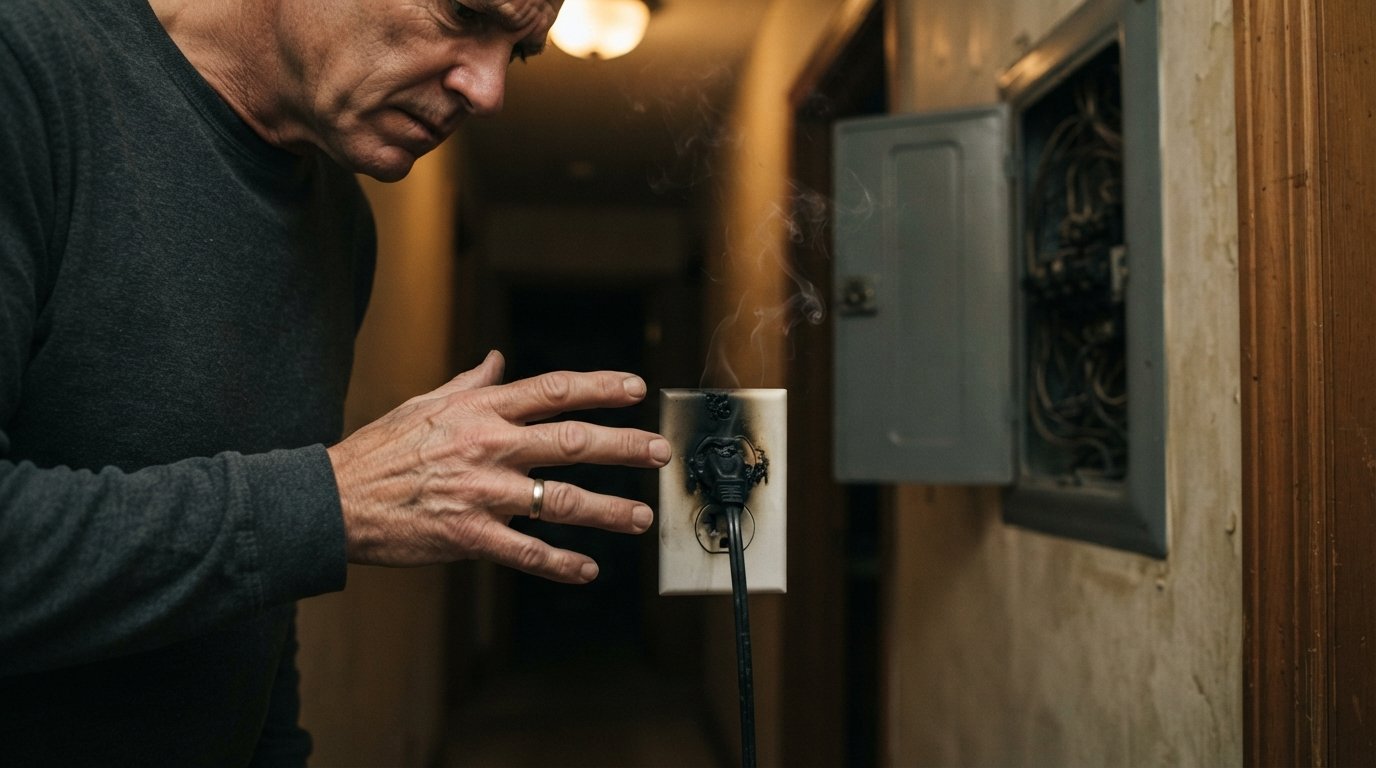
- Outlets that are hot to the touch, discolored, or have visible charring or melting around the plug holes
- Frequent circuit breaker trips, particularly if the same breaker trips multiple times in a week
- Buzzing, crackling, or sizzling sounds coming from your electrical panel, outlets, or switches
- Flickering or dimming lights, especially when you plug in an appliance or turn on a high-draw device
Each of these signs points to a specific failure mode. A burning smell often indicates that insulation is melting, which is a direct fire risk. A hot outlet means the internal connections are failing, and the heat could ignite nearby wall materials. Repeated breaker trips suggest an overloaded circuit or a short in the wiring. Buzzing sounds are often the result of arcing, where electricity jumps across a gap, generating extreme heat. And flickering lights can be a sign of a loose connection in the panel or at the utility service entrance. In all these cases, the problem will not resolve itself; it will only escalate.
The Hidden Costs of Delaying Electrical Repairs
When a light switch stops working, the immediate cost is $150 to $250 for a licensed electrician to fix it. When that same switch is left alone for a few months, the arcing inside the wall can melt the insulation on nearby wires, requiring the drywall to be opened and a section of the circuit to be replaced. Now the cost is closer to $800 to $1,200. If the arcing ignites the wood framing, you are looking at fire damage restoration, which averages $10,000 to $30,000 according to industry data. The math is simple: every day you wait multiplies the potential cost by a factor of ten or more.
Beyond the financial impact, there is the issue of safety. The National Fire Protection Association reports that electrical failures or malfunctions are a leading cause of home fires in the United States, accounting for roughly 13% of residential structure fires. These fires cause hundreds of deaths and over a billion dollars in property damage each year. The vast majority of these incidents could have been prevented with a timely inspection and repair. When you make the decision to call for emergency electrical repair before it worsens, you are not just spending money on a service; you are investing in the protection of your most valuable asset and the people who live in it.
What Happens During an Emergency Electrical Call
When you contact a licensed electrician for an emergency, the process is designed to be fast and thorough. The first step is a phone consultation where you describe the symptoms you are experiencing. Based on that description, the electrician will bring the appropriate tools and parts, which saves valuable time. Once on site, the electrician will perform a visual inspection of the affected area, then use a multimeter or thermal imaging camera to pinpoint the exact source of the problem.
After identifying the issue, the electrician will explain the situation in plain language and provide a clear estimate for the repair. You have the right to ask questions and understand the scope of work before any major changes are made. In many cases, the repair itself is straightforward: tightening a connection, replacing a damaged outlet, or installing a new breaker. The electrician will then test the circuit to ensure everything is working safely and will often provide a brief summary of the work performed, including any recommendations for future preventive maintenance.
How to Choose a Qualified Electrician for an Emergency
Speed is important in an emergency, but it should not come at the expense of quality. An unlicensed or uninsured handyman may offer a cheaper price, but the risk of improper work is high. A faulty repair can create a new hazard that is worse than the original problem. You should always verify that your electrician is licensed, insured, and has a solid track record of similar emergency repairs. Look for electricians who are responsive, can arrive within a few hours, and are willing to provide a written estimate before starting work.
A reliable way to find vetted professionals is to use a referral platform that pre-screens contractors. For example, FreeQuotes.Contractors connects homeowners with local electricians who have been vetted for licensing and insurance, and it allows you to receive multiple quotes so you can compare pricing and approach. This is especially valuable in an emergency, because it lets you see which pros are available in your area and what they charge, all without making a dozen phone calls. You can request a quote and have a qualified electrician on the way in under an hour.
Preventive Measures to Avoid Future Emergencies
Once the immediate crisis is resolved, it is wise to think about prevention. A professional electrician can perform a full home electrical audit, which involves checking the panel, testing all outlets and switches, and inspecting the wiring for signs of wear. They can also identify code violations, such as aluminum wiring or ungrounded outlets, that may not be urgent but could become problems in the future. An audit typically costs between $200 and $500, but it can save thousands by catching issues early.
In addition to a professional audit, there are simple habits you can adopt to reduce stress on your electrical system. Avoid plugging multiple high-wattage appliances into the same outlet or power strip. Use surge protectors for electronics. Have your panel inspected if your home is more than 30 years old, as older panels may not be equipped for modern electrical loads. And never ignore the warning signs we discussed earlier. A quick response to a flickering light or a warm outlet is the best prevention of all.
Your Home Deserves a Proactive Approach
Electrical emergencies are stressful, but they do not have to be catastrophic. The moment you notice a burning smell, a hot outlet, or a breaker that will not reset, you have a choice. You can wait, hope for the best, and risk a fire that could destroy your home. Or you can make the call, get a professional in quickly, and have the problem fixed correctly. The second option is almost always cheaper, and it is certainly safer.
Remember that the phrase "emergency electrical repair call before it worsens" is not just a slogan; it is a practical rule that protects your family and your finances. Use the resources available to you, like verified contractor directories, to find a skilled electrician who can respond promptly. In the end, the peace of mind that comes from knowing your home’s electrical system is safe is well worth the cost of a timely repair.
Learn more about Electrical and Wiring Repair for guides, costs, and what to expect.
Compare Electrical and Wiring Repair Pros Near You
Enter your ZIP code to compare top-rated local professionals and request free quotes.